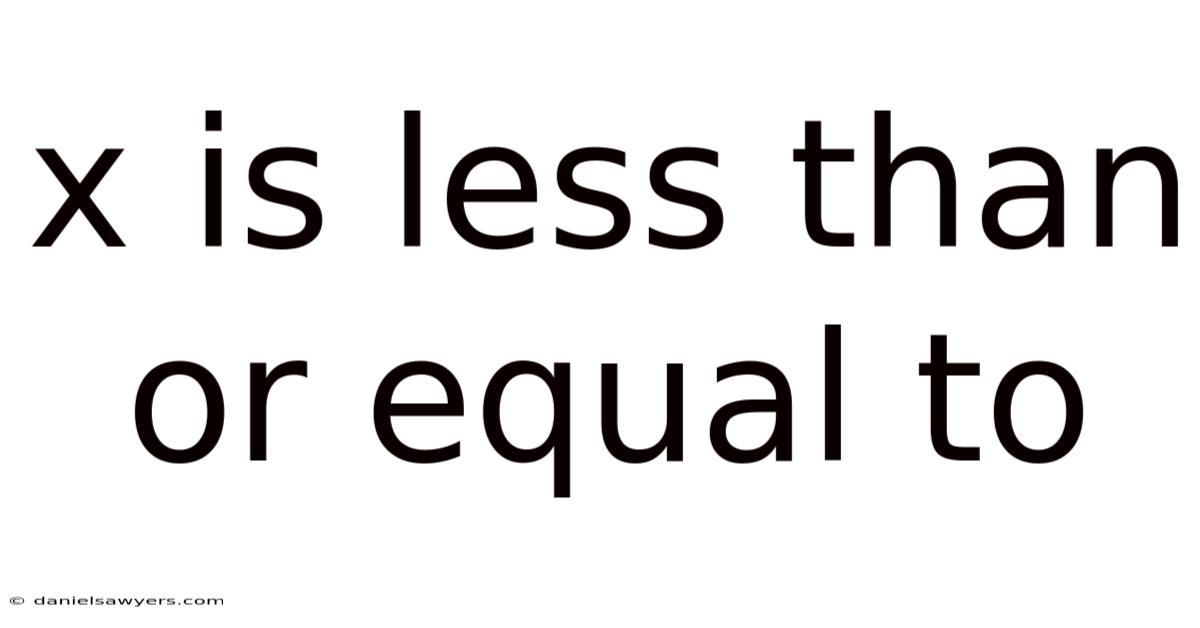
x is less than or equal to is a fundamental mathematical notation that appears in algebra, calculus, statistics, and many applied fields. The symbol “≤” combines the idea of “less than” (<) with “equal to” (=), allowing us to describe a range of values where a variable can be either strictly smaller or exactly the same as another quantity. Understanding how to read, write, and manipulate statements involving “x ≤ y” is essential for solving equations, analyzing functions, and interpreting data in both academic and real‑world contexts.
What the Symbol Means
The expression x ≤ y is read as “x is less than or equal to y.” It asserts that x can take any value that satisfies one of two conditions:
- x is strictly less than y (i.e., x < y), or
- x is exactly equal to y (i.e., x = y).
In set notation, the solution set for x ≤ y includes all numbers from negative infinity up to and including y. Graphically, on a number line, this is represented by a filled (solid) circle at y and a line extending to the left, indicating that every point left of y is also part of the solution.
Key Characteristics
- Inclusivity: The “or equal to” part makes the inequality inclusive. If you have x ≤ 5, the value x = 5 is a valid solution.
- Non‑strict vs. Strict: Some inequalities are strict (e.g., x < y), meaning the endpoint is excluded. The “≤” symbol is sometimes called a non‑strict inequality.
- Transitivity: If a ≤ b and b ≤ c, then a ≤ c. This property is useful when chaining multiple inequalities together.
How to Read and Write “x ≤ y”
Reading the Notation
- Verbal form: “x is less than or equal to y.”
- Mathematical shorthand: x ≤ y.
- Alternative phrasing: “x does not exceed y.” (The phrase “does not exceed” is often used in engineering and economics.)
Writing the Symbol
- Keyboard shortcuts: On most computers, you can type
≤usingCtrl+Shift+=(Windows) orOption+Shift+<(Mac). In LaTeX, the command is\le. - HTML entity:
≤renders the same symbol in web pages.
Common Uses in Mathematics
1. Solving Linear Inequalities
When solving ax + b ≤ c, the goal is to isolate x while preserving the inequality direction. The steps mirror those for equations, with one crucial rule:
- Multiplying or dividing by a negative number flips the inequality sign. As an example, solving
-2x ≤ 6yieldsx ≥ -3after dividing by-2.
2. Defining Domains and Ranges
Functions often have restrictions expressed with ≤. So for instance, the domain of f(x) = √(x - 2) is x ≥ 2, which can be rewritten as 2 ≤ x. This ensures the radicand is non‑negative Worth knowing..
3. Optimization Problems
In linear programming, constraints such as x ≤ 10 define feasible regions. The feasible region is the set of all points that satisfy every constraint simultaneously, often visualized as a polygon on a coordinate plane Easy to understand, harder to ignore..
4. Probability and Statistics
The cumulative distribution function (CDF) of a random variable X is defined as F(x) = P(X ≤ x). This probability includes the exact value of x, making the ≤ symbol essential for calculating tail probabilities.
Solving Inequalities with “≤”
Step‑by‑Step Example
Problem: Solve 3x - 5 ≤ 2x + 1.
-
Subtract
2xfrom both sides
3x - 2x - 5 ≤ 1→x - 5 ≤ 1Not complicated — just consistent. No workaround needed.. -
Add
5to both sides
x ≤ 6Simple, but easy to overlook.. -
Check the solution
- If
x = 6:3(6) - 5 = 13and2(6) + 1 = 13→ equality holds. - If
x = 0:3(0) - 5 = -5and2(0) + 1 = 1→-5 ≤ 1holds.
- If
Thus, the solution set is {x | x ≤ 6}.
Handling Special Cases
- Multiplying/Dividing by Zero: You cannot multiply or divide an inequality by zero; the operation is undefined.
- Adding/Subtracting Constants: These operations do not affect the direction of the inequality.
- Squaring Both Sides: This is only safe when both sides are known to be non‑negative, because squaring can reverse the order for negative numbers.
Real‑World Applications
1. Engineering and Physics
- Stress analysis: Materials must withstand stresses σ ≤ σ_yield, where σ_yield is the yield strength.
- Temperature limits: Operating temperatures often satisfy
T ≤ T_maxto avoid overheating.
2. Economics and Business
- Budget constraints: A company may require
Cost ≤ Revenueto ensure profitability. - Production limits: Factories might enforce
Output ≤ Capacityto prevent overextension.
3. Health and Medicine
- Drug dosage: Doses are prescribed such that
Dose ≤ Max_Doseto avoid toxicity. - Vital signs: Clinicians monitor
Heart_Rate ≤ Upper_Limitfor patient safety.
4. Environmental Science
- Pollution levels: Regulations often state
Pollutant ≤ Thresholdto protect ecosystems.
Tips for Working with “≤”
- Graph the solution: Visualizing the inequality on a number line or coordinate plane reinforces understanding.
- Check endpoints: Remember that ≤ includes the endpoint, so test the boundary value.
- Use interval notation: For x ≤ 7, the interval is
(-∞, 7]. The square bracket indicates inclusion. - Be cautious with multiplication/division: Always check the sign of the multiplier/divisor.
- Combine inequalities: When you have multiple ≤ statements, you can often combine them into a compound inequality, e.g.,
2 ≤ x ≤ 5.
Frequently Asked Questions
Q: Can “≤” be used with variables on both sides?
A: Yes. As an example, 2x ≤ 3x - 4 can be solved by moving terms and isolating x The details matter here..
Q: Does “≤” imply strict inequality in calculus limits?
A: No. In limit notation, x → a⁻ (approaching from the left) still uses ≤ when describing the domain of a function near a Not complicated — just consistent. Worth knowing..
Q: How does “≤” differ from “<” in optimization?
A: “≤” includes the boundary
the boundary, whereas “<” strictly excludes it. Still, in optimization, this distinction is critical: it determines whether the feasible region includes its edges, affects the applicability of certain solution methods, and influences whether an optimal value is attainable or merely approached as a limit. When formulating models, explicitly noting ≤ versus < ensures clarity in constraint handling, sensitivity analysis, and the interpretation of results.
This changes depending on context. Keep that in mind.
Conclusion
Inequalities such as ≤ are far more than notational conveniences—they are fundamental tools for defining limits, modeling constraints, and guiding decision-making across disciplines. That said, from engineering safety margins to economic feasibility, from medical dosing to environmental regulations, the ability to work confidently with ≤ and its counterparts enables precise translation of real-world conditions into mathematical language. Mastery comes from understanding how each algebraic operation affects the inequality’s direction, recognizing when special rules apply, and always verifying solutions against the original context Simple, but easy to overlook..
