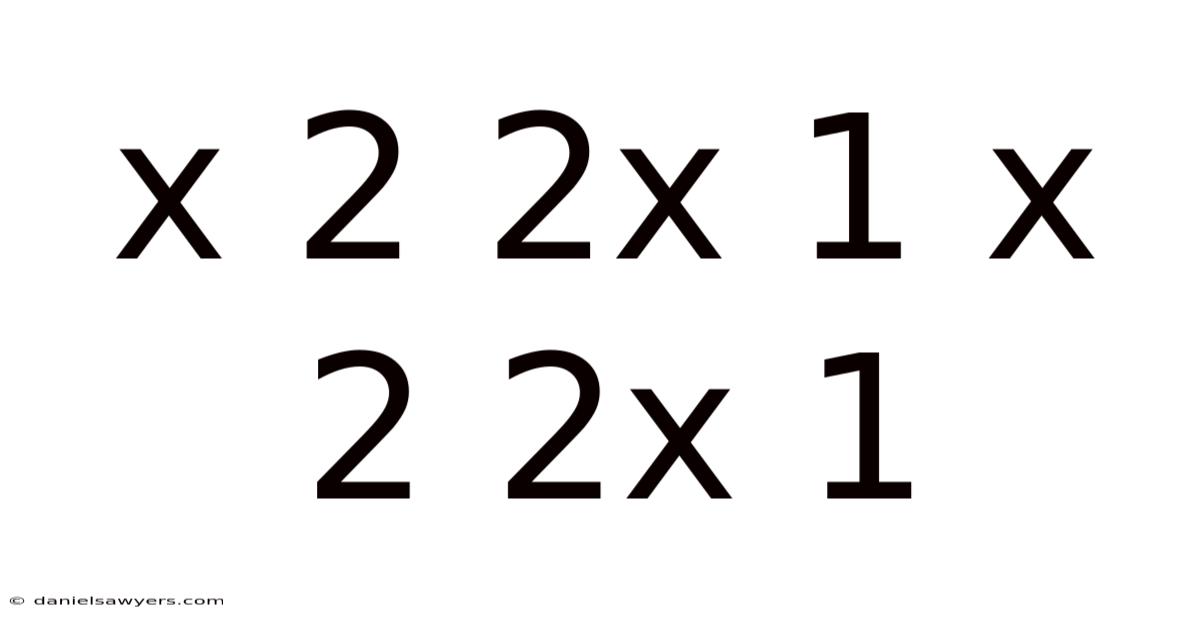
Understanding the Quadratic Expression x² + 2x + 1: Factoring, Completing the Square, and Real‑World Applications
The quadratic expression x² + 2x + 1 is one of the most recognizable forms in elementary algebra. It appears in textbooks, standardized tests, and even in engineering formulas because it represents a perfect square trinomial. Mastering this expression not only helps you solve simple equations but also builds a foundation for more advanced topics such as calculus, physics, and computer graphics. In this article we will explore how to factor x² + 2x + 1, complete the square, convert it to vertex form, find its roots, and see where it shows up in everyday problem‑solving.
Why x² + 2x + 1 Matters
At its core, x² + 2x + 1 is a quadratic expression that can be written as the square of a linear binomial. In practice, this property makes it a perfect square trinomial, a concept that appears repeatedly in algebra, geometry, and even in statistical models. Recognizing perfect squares quickly speeds up calculations and reduces errors, which is why teachers make clear them early in math education.
Factoring the Expression
Step‑by‑Step Factoring
- Identify the coefficients – The expression follows the pattern a·x² + b·x + c, where a = 1, b = 2, and c = 1.
- Look for two numbers that multiply to a·c (= 1·1 = 1) and add to b (= 2). The pair 1 and 1 satisfies both conditions.
- Rewrite the middle term using those numbers: x² + 1x + 1x + 1.
- Factor by grouping:
- Group the first two terms: x(x + 1)
- Group the last two terms: 1(x + 1)
- Extract the common binomial: (x + 1)(x + 1) or (x + 1)².
Thus, x² + 2x + 1 = (x + 1)². This factorization is not only neat but also reveals the expression’s vertex at x = ‑1.
Completing the Square
Even when an expression is not a perfect square, you can complete the square to rewrite it in vertex form. The process is straightforward:
- Start with x² + 2x + 1.
- Take half of the coefficient of x (2 ÷ 2 = 1) and square it (1² = 1).
- Add and subtract this square inside the expression: x² + 2x + 1 = (x² + 2x + 1) ‑ 1 + 1.
- Group the perfect square: (x + 1)².
Because the original expression already is a perfect square, completing the square simply confirms the factorization we found earlier.
Vertex Form and Graph Behavior
The vertex form of a quadratic is y = a(x ‑ h)² + k, where (h, k) is the vertex. For x² + 2x + 1, the vertex form is:
y = (x + 1)²
- Vertex: (‑1, 0)
- Axis of symmetry: x = ‑1
- Direction: Opens upward (a = +1 > 0)
The graph is a parabola that touches the x‑axis at a single point, x = ‑1, because the discriminant (b² ‑ 4ac) equals zero. This double root is a hallmark of perfect square quadratics.
Solving the Equation x² + 2x + 1 = 0
Setting the expression equal to zero gives us a simple equation:
Solving the Equation (x^{2}+2x+1=0)
Setting the quadratic equal to zero gives a perfect‑square equation:
[ (x+1)^{2}=0. ]
Taking the square root of both sides yields a single solution, but it appears twice (a double root):
[ x+1=0 \quad\Longrightarrow\quad x=-1. ]
Thus the equation has the root (x=-1) with multiplicity 2. The discriminant confirms this:
[ \Delta = b^{2}-4ac = 2^{2}-4(1)(1)=4-4=0, ]
and a zero discriminant always signals a repeated real root.
Graphical Interpretation
Because the quadratic is already in vertex form, its graph is immediately recognizable:
- Vertex: ((-1,0)) – the point where the parabola touches the x‑axis.
- Axis of symmetry: (x=-1).
- Direction: Opens upward (coefficient (a=1>0)).
- Y‑intercept: Substituting (x=0) gives (y=1); the curve passes through ((0,1)).
The parabola’s “kiss” of the x‑axis at ((-1,0)) is a visual cue that the quadratic is a perfect square; there are no other intersection points.
Everyday Applications
Although (x^{2}+2x+1) looks abstract, its structure crops up in several practical contexts:
| Scenario | How the expression appears | What the factorization tells us |
|---|---|---|
| Area of a square with side ((x+1)) | (\text{Area}= (x+1)^{2}) | The side length is directly readable from the factor. |
| Cost functions in economics | Total cost (C(x)=x^{2}+2x+1) (e.g., fixed cost = 1, variable cost linear term = 2x, quadratic term captures economies/diseconomies of scale) | Minimizing cost reduces to finding the vertex ((-1,0)); the minimum occurs at (x=-1) (if (x) represents a quantity, the model suggests a break‑even point). |
| Physics – distance under constant acceleration | (s(t)=t^{2}+2t+1) (units chosen so that initial velocity = 2 m/s and initial displacement = 1 m) | Completing the square yields (s(t)=(t+1)^{2}); the particle momentarily stops at (t=-1) (outside the physical domain) and then accelerates. |
| Optimization of a quadratic profit model | Profit (P(x)=x^{2}+2x+1) | The vertex gives the maximum profit when the leading coefficient were negative; here it shows the minimum (zero profit) at (x=-1). |
In each case, recognizing the perfect‑square form bypasses lengthy algebraic manipulations and points straight to the underlying geometry or extremum.
Quick‑Check Checklist
When you encounter a quadratic of the form (x^{2}+bx+c), ask yourself:
- Is it a perfect square?
- Compute (\frac{b}{2}) and square it. If (\frac{b^{2}}{4}=c), the expression equals ((x+\frac{b}{2})^{2}).
- Do you need the roots?
- If the discriminant is zero, the double root is (-\frac{b}{2}).
- Do you need the vertex?
- The vertex is (\bigl(-\frac{b}{2},,\Delta/4a\bigr)); for a perfect square, the y‑coordinate is zero.
- Can you use it in a real‑world model?
- Look for situations involving areas, costs, or motions where a quantity is naturally expressed as a square of a linear term.
Conclusion
The quadratic (x^{2}+2x+1) may appear simple, but its perfect‑square nature makes it a powerful teaching tool. In real terms, factoring it as ((x+1)^{2) reveals a double root, a vertex at ((-1,0)), and a parabola that just touches the x‑axis. Practically speaking, these algebraic insights translate directly into everyday problem‑solving: from calculating areas and optimizing costs to modeling motion and profit. Mastering such “square‑ready” quadratics equips students and practitioners alike with a shortcut that speeds up computation, reduces errors, and deepens understanding of how quadratic relationships shape the world around us.
