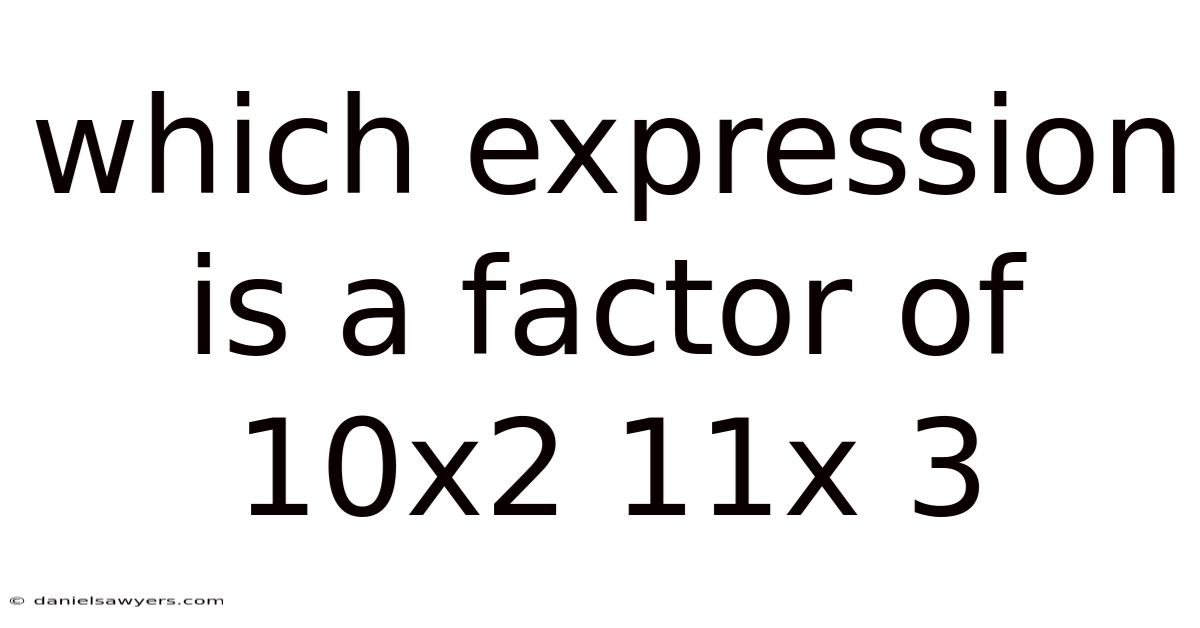
The quadratic expression 10x² + 11x + 3 can be factored into simpler binomials, and identifying its factors is a fundamental skill in algebra. Factoring polynomials is essential for solving equations, simplifying expressions, and understanding the behavior of functions. This article explains how to determine which expressions are factors of 10x² + 11x + 3, provides step-by-step guidance, and explores the underlying principles.
Steps to Factor the Quadratic Expression
To factor 10x² + 11x + 3, follow these steps:
1. Identify the Coefficients
The standard form of a quadratic is ax² + bx + c, where:
- a = 10 (coefficient of x²),
- b = 11 (coefficient of x),
- c = 3 (constant term).
2. Find Factor Pairs
- Factors of 10 (a): 1 × 10, 2 × 5, 4 × 2.5 (but 2.5 is not an integer, so skip it).
- Factors of 3 (c): 1 × 3.
3. Test Combinations
We need two binomials of the form (mx + n)(px + q) such that:
- m × p = 10,
- n × q = 3,
- (m × q) + (p × n) = 11 (the coefficient of the middle term).
4. Try Possible Pairs
-
Option 1: (2x + 1)(5x + 3)
Expand this:
2x × 5x = 10x²,
2x × 3 = 6x,
1 × 5x = 5x,
1 × 3 = 3.
Combine terms: 10x² + (6x + 5x) + 3 = 10x² + 11x + 3.
This matches the original expression. -
Option 2: (5x + 3)(2x + 1)
This is the same as above, just reordered. Multiplication is commutative, so the result is identical It's one of those things that adds up..
5. Verify the Factors
Always check your work by expanding the factors to ensure they equal the original expression. This confirms accuracy.
Scientific Explanation: Why Factoring Works
Factoring relies on the distributive property and the structure of polynomial multiplication. When multiplying two binomials like (mx + n)(px + q), the result is:
- **m × p
