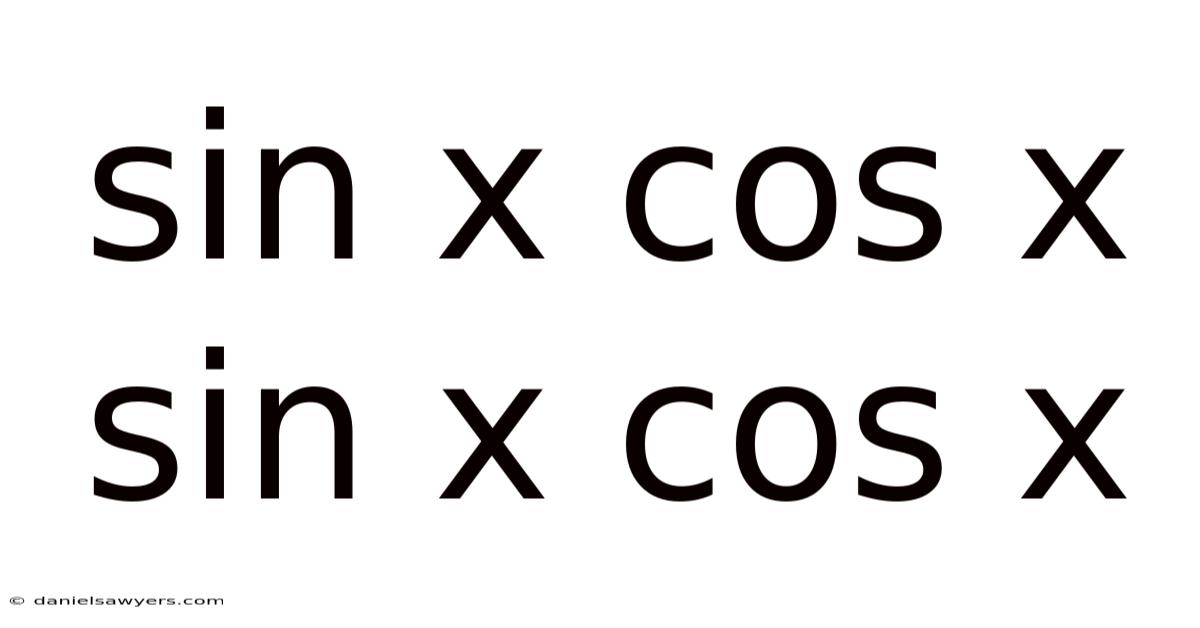
The expression sin x cos x sin x cos x appears in many trigonometric problems, and understanding its structure is the first step toward mastering related calculations. At first glance it looks like a simple repetition of two factors, but by rewriting it as (sin x cos x)² we open the door to a wealth of identities, differentiation rules, integration techniques, and real‑world applications. In this article we will explore each of these aspects in depth, providing clear explanations, step‑by‑step derivations, and practical examples.
Algebraic Simplification
Rewriting as a Square
The most immediate simplification is to recognize that multiplication is commutative and associative, so
[ \sin x,\cos x,\sin x,\cos x = (\sin x,\cos x)^2. ]
This form is useful because it reduces the number of factors from four to one squared term, making subsequent manipulations easier.
Using the Double‑Angle Identity
A powerful identity that involves the product of sine and cosine is
[ \sin(2x) = 2\sin x,\cos x. ]
From this we can express (\sin x,\cos x) as (\frac{1}{2}\sin(2x)). Substituting into the squared expression gives
[ (\sin x,\cos x)^2 = \left(\frac{1}{2}\sin(2x)\right)^2 = \frac{1}{4}\sin^2(2x). ]
Thus sin x cos x sin x cos x can be rewritten as (\frac{1}{4}\sin^2(2x)), a form that often simplifies integration and differentiation.
Trigonometric Identities
Expressing in Terms of (\sin(2x))
As shown above,
[ \sin x,\cos x = \frac{1}{2}\sin(2x), ]
so the original expression becomes
[ \frac{1}{4}\sin^2(2x). ]
This identity is especially handy when dealing with products of sine and cosine in integral forms That's the whole idea..
Expressing in Terms of (\cos(4x))
Using the power‑reduction formula
[ \sin^2\theta = \frac{1-\cos(2\theta)}{2}, ]
we can further transform (\frac{1}{4}\sin^2(2x)):
[ \frac{1}{4}\sin^2(2x) = \frac{1}{4}\cdot\frac{1-\cos(4x)}{2} = \frac{1-\cos(4x)}{8}. ]
Hence sin x cos x sin x cos x is equivalent to
... = (\frac{1-\cos(4x)}{8}). This compact form not only confirms the equivalence but also sets the stage for calculus operations That's the part that actually makes a difference. But it adds up..
Calculus Applications
Differentiation
Using the simplified form (\frac{1-\cos(4x)}{8}), differentiation becomes straightforward: [ \frac{d}{dx}\left(\frac{1-\cos(4x)}{8}\right) = \frac{4\sin(4x)}{8} = \frac{1}{2}\sin(4x). ] Alternatively, starting from (\frac{1}{4}\sin^2(2x))
Alternatively, starting from (\frac{1}{4}\sin^2(2x)) and applying the chain rule:
[ \frac{d}{dx}\left(\frac{1}{4}\sin^2(2x)\right) = \frac{1}{4}\cdot 2\sin(2x)\cdot\cos(2x)\cdot 2 = \sin(2x)\cos(2x) = \frac{1}{2}\sin(4x). ]
Both routes agree, which is a reassuring consistency check. Notice that the derivative (\frac{1}{2}\sin(4x)) is itself a single sinusoidal term, reflecting the fact that differentiating a squared sinusoid raises its frequency while preserving its smooth, periodic character Worth knowing..
Integration
Integration is where the power‑reduced form (\frac{1-\cos(4x)}{8}) truly shines, because it turns a product of trigonometric factors into a simple sum of elementary terms:
[ \int \frac{1-\cos(4x)}{8},dx = \frac{1}{8}\left(x - \frac{\sin(4x)}{4}\right) + C = \frac{x}{8} - \frac{\sin(4x)}{32} + C. ]
We can confirm this result by differentiating it: the derivative of (\frac{x}{8}) is (\frac{1}{8}), and the derivative of (-\frac{\sin(4x)}{32}) is (-\frac{4\cos(4x)}{32} = -\frac{\cos(4x)}{8}). Adding these gives (\frac{1-\cos(4x)}{8}), exactly the original integrand Still holds up..
The presence of the linear term (\frac{x}{8}) is significant. On top of that, it tells us that the expression does not integrate to a purely periodic function; instead, it accumulates area steadily over time. This is the mathematical signature of a quantity with a nonzero average value.
The Average Value
Over one full period of the underlying oscillation, the (\cos(4x)) term averages to zero, leaving only the constant contribution. As a result, the average value of sin x cos x sin x cos x is
[ \frac{1}{T}\int_0^{T}\frac{1-\cos(4x)}{8},dx = \frac{1}{8}. ]
This single number captures the "DC component" of the expression and appears repeatedly in physics and engineering, where it often represents mean power or mean energy.
Real‑World Applications
Physics: Oscillations and Waves
The product (\sin x\cos x) arises naturally when two oscillations meet. In the study of simple harmonic motion, the instantaneous power delivered by a spring is proportional to the product of displacement and velocity, both of which vary sinusoidally. Squaring such a product, as our expression does, models energy quantities that depend on the square of an amplitude.
Electrical Engineering: AC Power
In alternating‑current circuits, voltage and current vary sinusoidally, and instantaneous power is their product. When averaged over a cycle, the result depends on terms structurally identical to (\frac{1-\cos(4x)}{8}). The constant (\frac{1}{8}) that we identified as the average value is the direct analogue of the average power dissipated in a resistive load, and the (\cos(4x)) term represents the ripple that oscillates at
