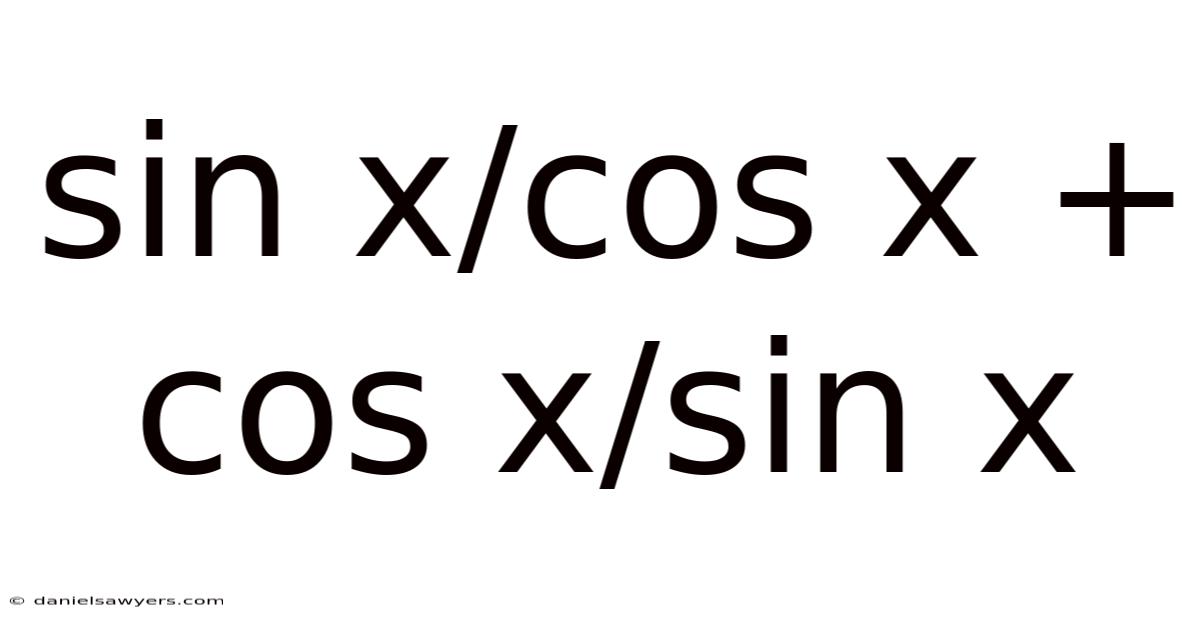
The combination sin x / cos x + cos x / sin x shows up in many trigonometric expressions and can be transformed into several equivalent forms that are easier to analyze or integrate. By recognizing the basic identities for tangent and cotangent, one can rewrite the sum as tan x + cot x, and further simplifications lead to expressions involving secant, cosecant, or a single rational function. Understanding how this expression behaves, how to differentiate it, and how to integrate it is essential for solving a wide range of problems in calculus, physics, and engineering Practical, not theoretical..
Simplification
The most direct simplification uses the definitions of the tangent and cotangent functions:
[ \frac{\sin x}{\cos x} = \tan x,\qquad \frac{\cos x}{\sin x} = \cot x. ]
Therefore
[ \frac{\sin x}{\cos x} + \frac{\cos x}{\sin x} = \tan x + \cot x. ]
A second step combines the two fractions over a common denominator:
[ \tan x + \cot x = \frac{\sin x}{\cos x} + \frac{\cos x}{\sin x} = \frac{\sin^2 x + \cos^2 x}{\sin x \cos x}. ]
Since (\sin^2 x + \cos^2 x = 1), the expression reduces to
[ \frac{1}{\sin x \cos x}. ]
This form can be written in several equivalent ways:
- (\displaystyle \frac{1}{
[ \frac{1}{\sin x \cos x} ]
- (\displaystyle \frac{2}{\sin 2x}), using the double-angle identity (\sin 2x = 2\sin x\cos x),
- (\displaystyle 2\csc 2x), since (\csc 2x = \dfrac{1}{\sin 2x}),
- (\displaystyle \sec x \csc x), because (\dfrac{1}{\sin x \cos x} = \dfrac{1}{\cos x}\cdot\dfrac{1}{\sin x}).
Each of these is valid wherever the original expression is defined, namely for (x \neq \dfrac{n\pi}{2}) with (n \in \mathbb{Z}), since both (\sin x) and (\cos x) must be nonzero.
Differentiation
Differentiating the form (\tan x + \cot x) is straightforward because the derivatives of tangent and cotangent are standard:
[ \frac{d}{dx}\left(\tan x + \cot x\right) = \sec^2 x - \csc^2 x. ]
This result can be checked against the compact form (\dfrac{1}{\sin x \cos x} = 2\csc 2x). Writing (f(x) = 2\csc 2x) and applying the chain rule,
[ f'(x) = 2\cdot\left(-\csc 2x \cot 2x\right)\cdot 2 = -4\csc 2x \cot 2x, ]
which is an equivalent expression for the same derivative, just packaged differently. The sign change reflects the fact that the original sum has minima where (\sin x \cos x) is largest.
Integration
The integral is most easily handled by splitting the sum and integrating each term:
[ \int \left(\tan x + \cot x\right),dx = \int \tan x,dx + \int \cot x,dx. ]
Using the standard antiderivatives (\displaystyle\int \tan x,dx = -\ln|\cos x| + C) and (\displaystyle\int \cot x,dx = \ln|\sin x| + C), we obtain
[ \int \left(\tan x + \cot x\right),dx = \ln|\sin x| - \ln|\cos x| + C = \ln\left|\tan x\right| + C. ]
The same answer follows from the compact form. Since (\dfrac{1}{\sin x \cos x} = 2\csc 2x),
[ \int 2\csc 2x,dx = \ln\left|\tan x\right| + C, ]
using (\displaystyle\int \csc u,du = \ln\left|\tan\tfrac{u}{2}\right| + C) with (u = 2x). The agreement of the two methods confirms the result The details matter here. Turns out it matters..
Series Expansion
The Maclaurin series for the sum reveals its singular behavior at the origin and the even symmetry of the function. Since $\tan x$ and $\cot x$ are odd functions, their sum is also odd; however, the singularity at $x=0$ (a simple pole) means the expansion is a Laurent series rather than a Taylor series. Using the known expansions
[ \tan x = x + \frac{x^3}{3} + \frac{2x^5}{15} + \frac{17x^7}{315} + \cdots ] [ \cot x = \frac{1}{x} - \frac{x}{3} - \frac{x^3}{45} - \frac{2x^5}{945} - \cdots, ]
adding them term-by-term yields
[ \tan x + \cot x = \frac{1}{x} + \frac{2x}{3} + \frac{2x^3}{15} + \frac{4x^5}{315} + \cdots = \frac{1}{x} + \sum_{n=1}^{\infty} \frac{2^{2n} B_{2n}}{(2n)!} x^{2n-1}, ]
where $B_{2n}$ are the Bernoulli numbers. The leading term $1/x$ confirms the simple pole at the origin with residue $1$, and the absence of even powers (other than the singular term) reflects the odd symmetry $f(-x) = -f(x)$. This series converges for $0 < |x| < \pi/2$, the distance to the nearest poles at $\pm \pi/2$.
Graphical Behavior and Extrema
The function $f(x) = \tan x + \cot x = 2\csc 2x$ is periodic with period $\pi$. On the fundamental interval $(0, \pi/2)$, the derivative $f'(x) = \sec^2 x - \csc^2 x$ vanishes when $\sec^2 x = \csc^2 x$, i.e., when $\sin^2 x = \cos^2 x$. This occurs at $x = \pi/4$. Since $f''(x) = 2\sec^2 x \tan x + 2\csc^2 x \cot x > 0$ on $(0, \pi/2)$, this critical point is a global minimum on the interval.
[ f\left(\frac{\pi}{4}\right) = \tan\frac{\pi}{4} + \cot\frac{\pi}{4} = 1 + 1 = 2. ]
Equivalently, by the AM–GM inequality applied to $\tan x$ and $\cot x$ (both positive on this interval),
[ \tan x + \cot x \ge 2\sqrt{\tan x \cot x} = 2, ]
with equality exactly at $x = \pi/4$. That said, on the adjacent interval $(\pi/2, \pi)$, both tangent and cotangent are negative, the function is negative, and it achieves a local maximum of $-2$ at $x = 3\pi/4$. As $x$ approaches the endpoints $0$ or $\pi/2$, the function diverges to $+\infty$. This alternating pattern of vertical asymptotes at $x = n\pi/2$ and alternating extrema of $\pm 2$ at the midpoints characterizes the graph entirely Still holds up..
Complex Extension
Extending the variable to the complex plane $z \in \mathbb{C}$, the identity $\tan z + \cot z = 2\csc 2z$ remains valid as an identity of meromorphic functions. The poles are simple and located at $z = n\pi/2$ for $n \in \mathbb{Z}$, with residues $\operatorname{Res}(f, n\pi/2) = (-1)^n$. The function is periodic with period $\pi$ and satisfies the differential equation
[ f'(z) = -f(z) \sqrt{f(z)^2 - 4}, ]
derived from the identity $\csc^2 w - \cot^2 w = 1$ with $w = 2z$. This Riccati-type equation highlights the algebraic relationship between the function and its derivative, a feature often exploited in the integration of rational functions of trigonometric expressions via the tangent half-angle substitution $t = \tan x$.
Conclusion
The expression $\tan x + \cot x$ serves as a compact nexus connecting fundamental trigonometric identities, calculus operations, and analytic structure. Its simplification to forms such as $2\csc 2x$ or $\sec x \csc x$ is not merely algebraic housekeeping; it dictates the most efficient strategies for differentiation and integration, reveals the location and nature of singularities, and determines the global extrema via elementary inequalities. Whether viewed as a real-valued function on restricted domains or a meromorphic function on the complex plane, the sum of tangent and cotangent exemplifies how a seemingly composite expression often conceals a simpler, more symmetric core structure—here, the double-angle cosecant—that governs all
its analytic and geometric behavior. The journey from a sum of two basic ratios to the elegant singularity structure of $2\csc 2z$ illustrates a central theme of mathematics: that simplicity often lies on the other side of complexity, waiting to be uncovered by the right change of perspective. Mastery of such equivalences transforms $\tan x + \cot x$ from a computational obstacle into a versatile tool, equally at home in a first-year calculus integral, a complex analysis residue calculation, or an inequality proof.
