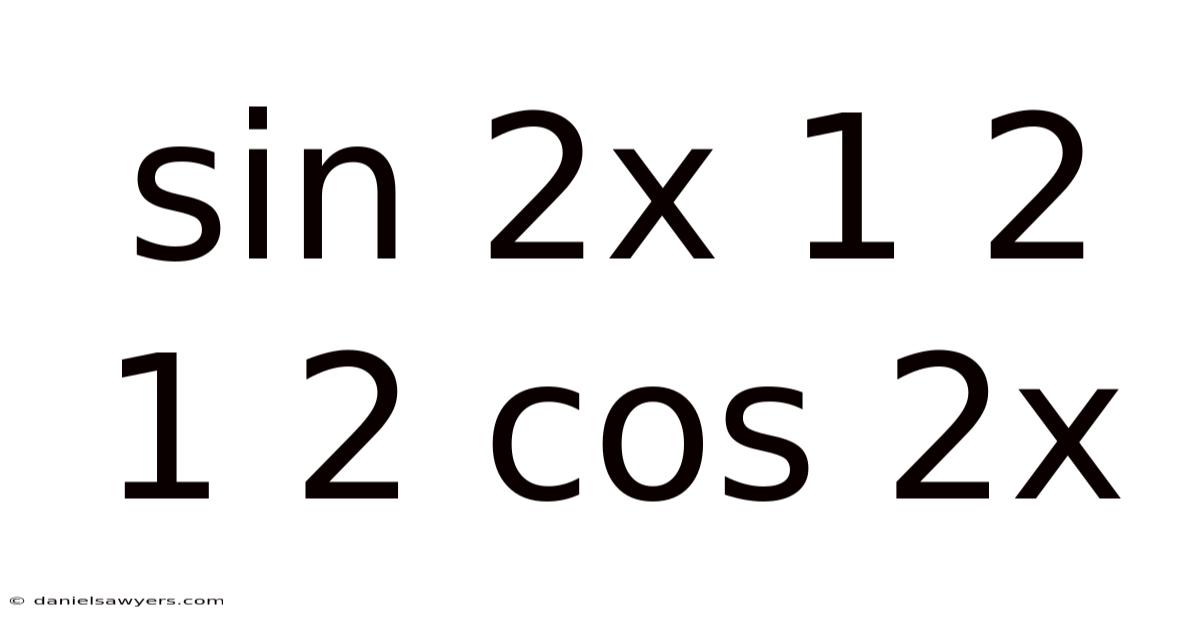
Understanding the Double-Angle Identities: sin 2x = 2 sin x cos x and cos 2x Forms
The double-angle identities are fundamental tools in trigonometry that allow the simplification and manipulation of trigonometric expressions involving angles multiplied by two. Among these identities, sin 2x = 2 sin x cos x stands out as a cornerstone formula, while the cosine double-angle identities offer multiple equivalent forms: cos 2x = cos²x - sin²x = 2 cos²x - 1 = 1 - 2 sin²x. These identities are not only essential for solving complex trigonometric equations but also play a critical role in fields such as physics, engineering, and signal processing. This article explores the derivation, applications, and nuances of these identities, providing a practical guide for students and professionals alike.
Derivation of sin 2x = 2 sin x cos x
The identity sin 2x = 2 sin x cos x can be derived using the sine addition formula. Recall that for any angles A and B, the sine addition formula states:
[ \sin(A + B) = \sin A \cos B + \cos A \sin B ]
To derive the double-angle identity, let A = B = x. Substituting these values into the formula:
[ \sin(x + x) = \sin x \cos x + \cos x \sin x ]
Simplifying the right-hand side:
[ \sin 2x = 2 \sin x \cos x ]
This derivation confirms the identity and highlights its connection to the broader set of addition formulas. The result is a powerful tool for expressing the sine of a double angle in terms of the sine and cosine of the original angle That's the part that actually makes a difference..
Example 1: Applying sin 2x = 2 sin x cos x
Suppose we need to simplify sin 60°. Recognizing that 60° = 2 × 30°, we can rewrite the expression using the double-angle identity:
[ \sin 60° = \sin(2 \times 30°) = 2 \sin 30° \cos 30° ]
Substituting known values (sin 30° = 0.5, cos 30° = √3/2):
[ \sin 60° = 2 × 0.5 × \frac{\sqrt{3}}{2} = \frac{\sqrt{3}}{2} ]
This example demonstrates how the identity can simplify calculations, especially when working with angles that are multiples of common reference angles Worth keeping that in mind..
Exploring the Cosine Double-Angle Identities
The cosine double-angle identity is more versatile than its sine counterpart, offering three equivalent forms:
- cos 2x = cos²x - sin²x
- cos 2x = 2 cos²x - 1
- cos 2x = 1 - 2 sin²x
These forms arise from the cosine addition formula and the Pythagorean identity (**sin²x + cos²x = 1
