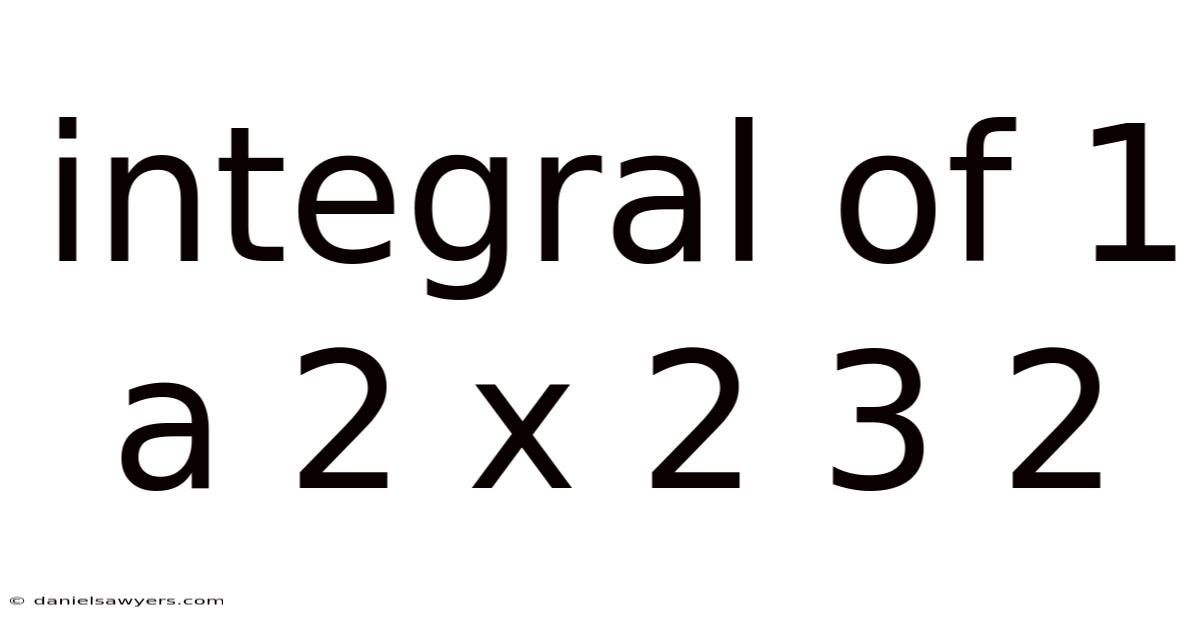
Integral of (\displaystyle \frac{1}{a^{2}x^{2}+3x+2}) – A Complete Guide
The integral of a rational function whose denominator is a quadratic polynomial appears frequently in calculus, physics, and engineering problems. One typical example is
[ I=\int \frac{dx}{a^{2}x^{2}+3x+2}, ]
where (a) is a real constant (often non‑zero). Evaluating this integral requires a blend of algebraic manipulation—completing the square or factoring—and knowledge of standard antiderivatives such as the natural logarithm and the inverse tangent. In this article we walk through the entire process, discuss the different cases that arise depending on the discriminant of the quadratic, illustrate the method with concrete numbers, and highlight common pitfalls. By the end you will have a solid, step‑by‑step toolkit for tackling (\displaystyle \int \frac{dx}{a^{2}x^{2}+3x+2}) and similar integrals.
1. Why This Integral Matters
Quadratic denominators model many real‑world phenomena: the motion of a damped harmonic oscillator, the response of an RC circuit, or the probability density of certain distributions. And when the numerator is a constant (here, 1), the integral often represents an accumulated quantity—such as total charge, area under a curve, or a cumulative probability. Mastering its evaluation therefore bridges pure calculus and applied sciences Practical, not theoretical..
2. Preliminary Observations
The integrand
[ f(x)=\frac{1}{a^{2}x^{2}+3x+2} ]
is a proper rational function because the degree of the numerator (0) is less than the degree of the denominator (2). No polynomial long division is needed. The denominator can be tackled in two main ways:
- Factoring (if the quadratic has real roots).
- Completing the square (always works, leading to an arctangent form).
The choice depends on the discriminant
[ \Delta = b^{2}-4ac = 3^{2}-4\cdot a^{2}\cdot 2 = 9-8a^{2}. ]
Three regimes emerge:
| Regime | Condition on (a) | Nature of roots | Antiderivative form |
|---|---|---|---|
| Two distinct real roots | (\Delta>0 ;\Rightarrow; | a | <\frac{3}{2\sqrt{2}}) |
| One repeated real root | (\Delta=0 ;\Rightarrow; | a | =\frac{3}{2\sqrt{2}}) |
| Complex conjugate roots | (\Delta<0 ;\Rightarrow; | a | >\frac{3}{2\sqrt{2}}) |
We will treat each case separately.
3. Case 1 – Two Distinct Real Roots ((|a|<\frac{3}{2\sqrt{2}}))
When (\Delta>0) the quadratic factors as
[ a^{2}x^{2}+3x+2 = a^{2}(x-r_{1})(x-r_{2}), ]
where
[ r_{1,2}= \frac{-3\pm\sqrt{9-8a^{2}}}{2a^{2}}. ]
3.1 Partial‑Fraction Decomposition
We write
[ \frac{1}{a^{2}x^{2}+3x+2}= \frac{A}{x-r_{1}}+\frac{B}{x-r_{2}}. ]
Multiplying both sides by the denominator gives
[ 1 = A a^{2}(x-r_{2}) + B a^{2}(x-r_{1}). ]
Collecting coefficients of (x) and the constant term yields a linear system:
[ \begin{cases} A a^{2}+B a^{2}=0 \[4pt]
- A a^{2} r_{2} - B a^{2} r_{1}=1 \end{cases} ;\Longrightarrow; \begin{cases} A+B=0 \[4pt] A r_{2}+B r_{1}= -\dfrac{1}{a^{2}}. \end{cases} ]
From (A=-B) we substitute into the second equation:
[ -B r_{2}+B r_{1}= -\frac{1}{a^{2}} ;\Longrightarrow; B(r_{1}-r_{2})=-\frac{1}{a^{2}}. ]
Since (r_{1}\neq r_{2}),
[ B = -\frac{1}{a^{2}(r_{1}-r_{2})},\qquad A = \frac{1}{a^{2}(r_{1}-r_{2})}. ]
3.2 Integration
Now
[ \int\frac{dx}{a^{2}x^{2}+3x+2}= \frac{1}{a^{2}(r_{1}-r_{2})}\int!\left(\frac{dx}{x-r_{1}}-\frac{dx}{x-r_{2}}\right). ]
Each term integrates to a natural logarithm:
[ \boxed{ I = \frac{1}{a^{2}(r_{1}-r_{2})}, \ln\left|\frac{x-r_{1}}{x-r_{2}}\right| + C, } ]
where (C) is the constant of integration. Substituting the explicit expressions for (r_{1,2}) yields a formula solely in terms of (a) and (x).
4. Case 2 – One Repeated Real Root ((|a|=\frac{3}{2\sqrt{2}}))
Here (\Delta=0) and the quadratic becomes a perfect square:
[ a^{2}x^{2}+3x+2 = a^{2}\left(x+\frac{3}{2a^{2}}\right)^{2}. ]
Let
[ u = x+\frac{3}{2a^{2}} \quad\Rightarrow\quad du = dx. ]
The integral simplifies to
[ I = \int \frac{du}{a^{2}u^{2}} = \frac{1}{a^{2}}\int u^{-2},du = -\frac{1}{
