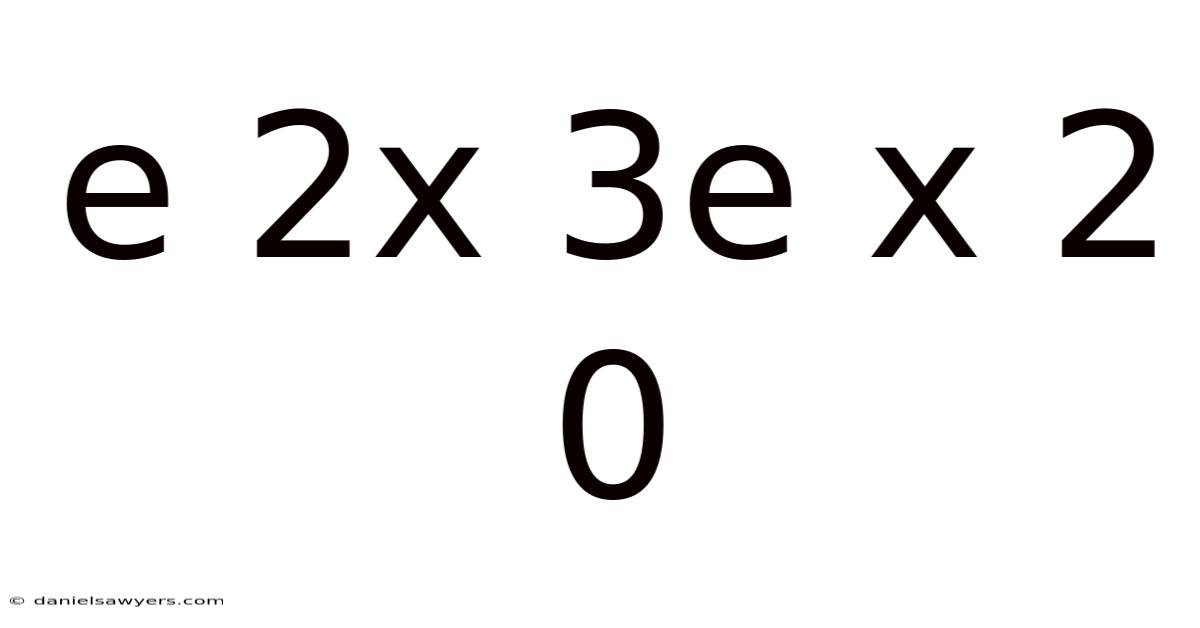
Solving the Exponential Equation (e^{2x}+3e^{x}+2=0): A Step‑by‑Step Guide
Exponential equations appear frequently in mathematics, physics, finance, and biology. They often look intimidating because the variable sits in the exponent, but many of them can be reduced to familiar algebraic forms through substitution. The equation
[ e^{2x}+3e^{x}+2=0 ]
is a classic example: it is quadratic in the quantity (e^{x}). By treating (e^{x}) as a single variable, we can apply the quadratic formula, factor, or complete the square—just as we would with any ordinary quadratic. In this article we will walk through the entire solution process, explain why each step works, and discuss the implications of the result. Whether you are a high‑school student encountering exponentials for the first time or a college learner reviewing logarithmic‑exponential relationships, this guide aims to build both procedural fluency and conceptual insight Not complicated — just consistent. Which is the point..
1. Why This Equation Looks Quadratic
At first glance the presence of the exponential function (e^{(\cdot)}) might suggest we need advanced calculus tools. Even so, notice the pattern:
- The term (e^{2x}) can be rewritten as ((e^{x})^{2}) because ((e^{x})^{2}=e^{x\cdot2}=e^{2x}).
- The term (3e^{x}) is linear in (e^{x}).
- The constant term (2) does not involve (x) at all.
If we let
[ u = e^{x}, ]
then the original equation becomes
[ u^{2}+3u+2=0, ]
which is a standard quadratic equation in the variable (u). This substitution is the key that transforms an exponential problem into an algebraic one we already know how to solve Took long enough..
2. Solving the Quadratic in (u)
2.1 Factoring (the simplest route)
The quadratic (u^{2}+3u+2) factors neatly:
[ u^{2}+3u+2 = (u+1)(u+2). ]
Setting each factor equal to zero gives the candidate solutions for (u):
[ \begin{cases} u+1=0 ;\Rightarrow; u=-1,\[4pt] u+2=0 ;\Rightarrow; u=-2. \end{cases} ]
2.2 Applying the Quadratic Formula (for completeness)
If factoring is not obvious, the quadratic formula
[ u=\frac{-b\pm\sqrt{b^{2}-4ac}}{2a} ]
with (a=1,;b=3,;c=2) yields
[ u=\frac{-3\pm\sqrt{9-8}}{2} =\frac{-3\pm1}{2} ={-1,,-2}, ]
confirming the factorization result Most people skip this — try not to..
3. Returning to the Original Variable (x)
Recall that we defined (u=e^{x}). The exponential function (e^{x}) is always positive for real (x) (its range is ((0,\infty))). Because of this, any solution that forces (e^{x}) to be zero or negative is extraneous in the real number system.
- For (u=-1): we would need (e^{x}=-1). No real (x) satisfies this because the exponential never outputs a negative number.
- For (u=-2): similarly, (e^{x}=-2) has no real solution.
Thus, there are no real values of (x) that satisfy the original equation.
4. Exploring Complex Solutions (Optional Extension)
If we allow (x) to be a complex number, the exponential function can take on negative or even complex values via Euler’s formula:
[ e^{a+bi}=e^{a}\bigl(\cos b+i\sin b\bigr). ]
Setting (e^{x}=-1) leads to
[ e^{x}=e^{i\pi+2k\pi i}\quad (k\in\mathbb{Z}), ]
so
[ x = i\pi+2k\pi i = i\pi(2k+1). ]
Similarly, (e^{x}=-2) gives
[ e^{x}=2e^{i\pi+2k\pi i};\Rightarrow; x=\ln 2 + i\pi(2k+1). ]
Hence the complex solution set is
[ \boxed{x = i\pi(2k+1)\quad\text{or}\quad x=\ln 2 + i\pi(2k+1),\qquad k\in\mathbb{Z}}. ]
These solutions illustrate how the exponential function’s periodicity in the imaginary direction produces infinitely many answers once we leave the real line Still holds up..
5. Scientific Explanation: Why No Real Roots Exist
The function (f(x)=e^{2x}+3e^{x}+2) is a sum of three strictly positive terms for any real (x):
- (e^{2x}>0) because the exponential of any real number is positive.
- (3e^{x}>0) for the same reason.
- The constant (2>0).
Adding three positive numbers can never yield zero; the smallest possible value occurs when each exponential term is as small as possible, i.e., as (x\to -\infty) Worth keeping that in mind. Surprisingly effective..
[ \lim_{x\to-\infty} f(x)=2. ]
Thus the function’s global minimum is (2), attained only in the limit as (x) goes to negative infinity. Since the function never dips below (2), the equation (f(x)=0) has no real solution.
Graphically, the curve (y=e^{2x}+3e^{x}+2) lies entirely above the (x)-axis, confirming the algebraic conclusion.
6. Frequently Asked Questions (FAQ)
Q1: Could I have solved the equation by taking logarithms directly?
A: Taking (\ln) of both sides would require the argument to be a single exponential term, e.g., (\ln(e^{2x}) = 2x). Because we have a sum of exponentials, logarithms do not distribute over addition, so this approach does not simplify the problem No workaround needed..
Q2: Why did we substitute (u=e^{x}) instead of (u=e^{2x})?
A: The substitution must linearize the highest‑power term. Choosing (u=e^{x}) makes (e^{2x}=u^{2}), turning the equation into a quadratic. Using (u=e^{2x}) would leave a term
Using (u=e^{2x}) would leave a term involving (\sqrt{u}) because (e^{x}= \sqrt{u}). The equation would then read
[ u+3\sqrt{u}+2=0, ]
which is not a polynomial in (u); solving it requires isolating the radical and squaring, steps that inevitably re‑introduce the original exponential form and do not simplify the problem. The substitution (u=e^{x}) is therefore preferred because it converts the sum of exponentials into a genuine quadratic, allowing straightforward factorization That's the part that actually makes a difference..
An alternative viewpoint comes from calculus. Differentiating
[ f(x)=e^{2x}+3e^{x}+2 ]
gives
[ f'(x)=2e^{2x}+3e^{x}>0\quad\text{for all real }x, ]
so (f) is strictly increasing on (\mathbb{R}). Its limits are
[ \lim_{x\to-\infty}f(x)=2,\qquad \lim_{x\to+\infty}f(x)=+\infty. ]
Since the function never drops below its asymptotic lower bound of 2, it can never attain the value 0. This monotonicity argument reinforces the algebraic conclusion that no real (x) satisfies (e^{2x}+3e^{x}+2=0).
In the complex domain, however, the periodicity of the exponential function yields infinitely many solutions, namely
[ x=i\pi(2k+1)\quad\text{or}\quad x=\ln 2+i\pi(2k+1),\qquad k\in\mathbb{Z}. ]
These arise from solving (e^{x}=-1) and (e^{x}=-2) and reflect the fact that the complex exponential maps horizontal strips of height (2\pi) onto the punctured plane (\mathbb{C}\setminus{0}).
Conclusion:
Over the real numbers the expression (e^{2x}+3e^{x}+2) is always positive, with a minimum value of 2 approached as (x\to-\infty); consequently the equation has no real roots. Allowing complex arguments unlocks an infinite lattice of solutions spaced by (2\pi i) along the imaginary axis, illustrating how the exponential’s periodic nature in the complex plane resolves the apparent impossibility encountered on the real line.
