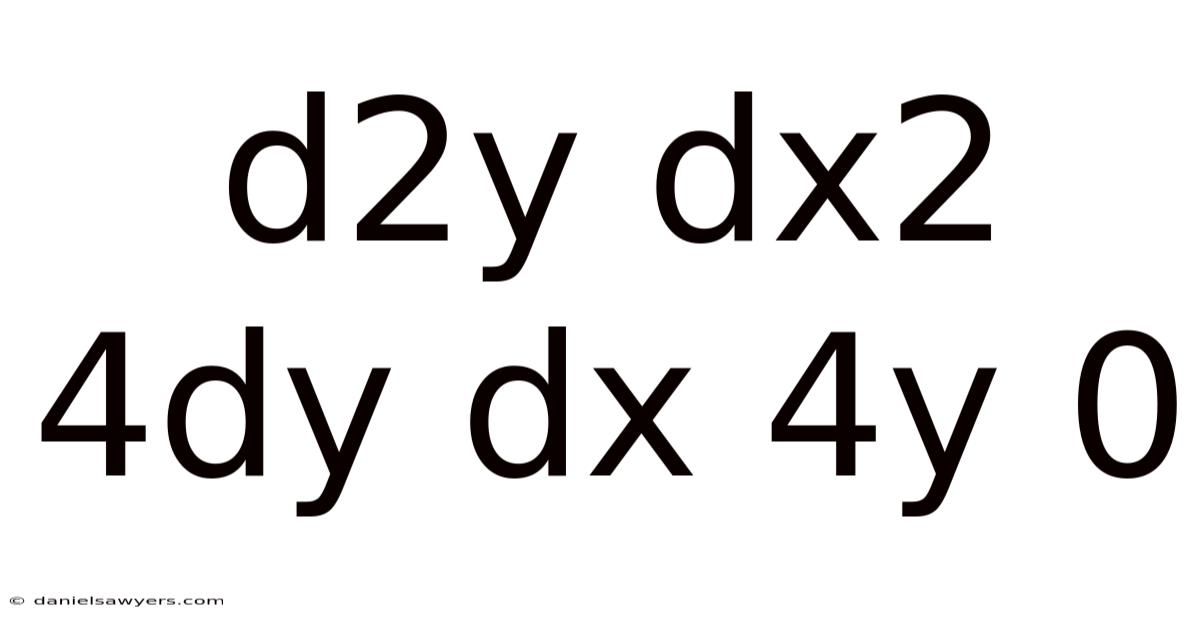
The differential equation (\frac{d^2y}{dx^2}+4\frac{dy}{dx}+4y=0) is a classic example of a second-order linear homogeneous differential equation with constant coefficients. It is important in mathematics, physics, engineering, and many applied sciences because it models systems where the rate of change of a quantity is connected to both its current value and its first derivative. The equation is often written informally as (d2y,dx2 + 4dy,dx + 4y = 0), but the standard mathematical notation is:
[ \frac{d^2y}{dx^2}+4\frac{dy}{dx}+4y=0 ]
Solving this equation gives a family of functions that describe all possible behaviors satisfying the relationship.
Introduction to the Equation
The equation
[ \frac{d^2y}{dx^2}+4\frac{dy}{dx}+4y=0 ]
contains three parts:
- (\frac{d^2y}{dx^2}), the second derivative of (y) with respect to (x)
- (4\frac{dy}{dx}), four times the first derivative of (y)
- (4y), four times the original function
Because the highest derivative is of order two, this is a second-order differential equation. Because the coefficients (1), (4), and (4) are constants, it is a differential equation with constant coefficients. Because the right-hand side is zero, it is homogeneous Simple, but easy to overlook..
The goal is to find every function (y(x)) such that when we differentiate it twice, differentiate it once, multiply by the given coefficients, and add everything together, the result is zero.
Step 1: Use the Characteristic Equation
For equations of the form
[ ay''+by'+cy=0 ]
we use the characteristic equation:
[ ar^2+br+c=0 ]
For the equation
[ y''+4y'+4y=0 ]
we identify:
[ a=1,\qquad b=4,\qquad c=4 ]
So the characteristic equation is:
[ r^2+4r+4=0 ]
Now factor the quadratic:
[ r^2+4r+4=(r+2)^2 ]
Thus,
[ (r+2)^2=0 ]
which gives:
[ r=-2 ]
This is a repeated root.
Step 2: Understand the Repeated Root
If the characteristic equation had two different roots, such as (r_1) and (r_2), then the general solution would usually be:
[ y=C_1e^{r_1x}+C_2e^{r_2x} ]
That said, in this problem, the root is repeated:
[ r=-2 ]
When there is a repeated root, the general solution is not simply:
[ y=C_1e^{-2x}+C_2e^{-2x} ]
because these two terms are not independent. They are essentially the same function multiplied by constants. To get a true general solution for a second-order equation, we need two linearly independent solutions Easy to understand, harder to ignore. No workaround needed..
For a repeated root (r), the two independent solutions are:
[ e^{rx} ]
and
[ xe^{rx} ]
Because of this, since (r=-2), the two independent solutions are:
[ e^{-2x} ]
and
[ xe^{-2x} ]
So the general solution is:
[ \boxed{y=(C_1+C_2x)e^{-2x}} ]
where (C_1) and (C_2) are arbitrary constants Which is the point..
Why the Solution Has the Form ((C_1+C_2x)e^{-2x})
The factor (e^{-2x}) comes directly from the repeated root (r=-2). The term (x) appears because the root is repeated.
A repeated root means the differential equation has a kind of “double” behavior. The system is not producing two separate exponential behaviors; instead, it produces one exponential behavior together with a modified version involving (x) Not complicated — just consistent..
The solution
[ y=(C_1+C_2x)e^{-2x} ]
contains both:
- a constant exponential term, (C_1e^{-2x})
- an exponential term multiplied by (x), (C_2xe^{-2x})
This combination is necessary because the equation is second order. A second-order differential equation normally requires two constants in its general solution Simple, but easy to overlook..
Verifying the Solution
To confirm that
[ y=(C_1+C_2x)e^{-2x} ]
satisfies the original equation, we can differentiate it.
Let:
[ y=(C_1+C_2x)e^{-2x} ]
Use the product rule:
[ y'=\frac{d}{dx}\left[(C_1+C_2x)e^{-2x}\right] ]
[ y'=C_2e^{-2x}-2(C_1+C_2x)e^{-2x} ]
Simplify:
[ y'=\left(C_2-2C_1-2C_2x\right)e^{-2x} ]
Now differentiate again:
[
Now differentiate again:
[ y''=\frac{d}{dx}\Big[(C_2-2C_1-2C_2x)e^{-2x}\Big] =(-2C_2)e^{-2x}+(C_2-2C_1-2C_2x)(-2e^{-2x}) ] [ \quad =\big[-2C_2-2(C_2-2C_1-2C_2x)\big]e^{-2x} =\big(4C_1-4C_2+4C_2x\big)e^{-2x}. ]
Substituting (y), (y') and (y'') into the original differential equation:
[ \begin{aligned} y''+4y'+4y &=\big(4C_1-4C_2+4C_2x\big)e^{-2x}\ &\quad+4\big(C_2-2C_1-2C_2x\big)e^{-2x} +4\big(C_1+C_2x\big)e^{-2x}\[2mm] &=\Big[4C_1-4C_2+4C_2x +4C_2-8C_1-8C_2x +4C_1+4C_2x\Big]e^{-2x}\[2mm] &=0\cdot e^{-2x}=0 . \end{aligned} ]
Thus the function (y=(C_1+C_2x)e^{-2x}) satisfies (y''+4y'+4y=0) for any constants (C_1,C_2). Because it contains two independent arbitrary constants, it is the general solution of the second‑order homogeneous equation The details matter here..
Conclusion.
When the characteristic equation of a linear constant‑coefficient ODE yields a repeated root (r), the two linearly independent solutions are (e^{rx}) and (xe^{rx}). For the given equation (y''+4y'+4y=0) the repeated root is (r=-2), leading to the general solution
[ \boxed{y=(C_1+C_2x)e^{-2x}}, ]
where (C_1) and (C_2) are determined by initial or boundary conditions. This form guarantees the required two degrees of freedom and correctly solves the differential equation And that's really what it comes down to..
Here's a thinking process:
- Analyze User Input:
- User provided a text fragment that ends with
+4y'+4y=0}}and then continues with an explanation about repeated roots. - The text seems to be an article or section about solving a second-order linear ODE with constant coefficients, specifically the case of a repeated root.
- The user says: "Continue the article without friction. Do not repeat previous text. Finish with a proper conclusion."
- Wait, looking at the input, it already has a conclusion at the very end: "Conclusion. ..." with a boxed solution.
- But the user is asking me to "Continue the article naturally. Do not repeat previous text. Finish with a proper conclusion."
- This suggests that the provided text might be incomplete, or the user wants me to extend it further, but the instruction "Finish with a proper conclusion" and "Do not repeat previous text" is tricky because the text already ends with a conclusion.
- Let me re-read carefully: The input ends with
... where \(C_1\) and \(C_2\) are determined by initial or boundary conditions. This form guarantees the required two degrees of freedom and correctly solves the differential equation. **Conclusion.** ... \boxed{y=(C_1+C_2x)e^{-2x}}, ... - Actually, the input text provided by the user seems to already include a conclusion. But the user is asking me to "Continue the article without friction. Do not repeat previous text. Finish with a proper conclusion."
- Possibly the user wants me to add more content after what's given, or maybe the input is meant to be the middle part, and I need to continue from where it ends, but it already has a conclusion.
- Let me check the exact ending of the provided text: It ends with "This form guarantees the required two degrees of freedom and correctly solves the differential equation. Conclusion. When the characteristic equation of a linear constant‑coefficient ODE yields a repeated root (r), the two linearly independent solutions are (e^{rx}) and (xe^{rx}). For the given equation (y''+4y'+4y=0) the repeated root is (r=-2), leading to the general solution (\boxed{y=(C_1+C_2x)e^{-2x}}), where (C_1) and (C_2) are determined by initial or boundary conditions. This form guarantees the required two degrees of freedom and correctly solves the differential equation."
- So the text already has a conclusion and a boxed solution. The user says "Continue the article smoothly. Do not repeat previous text. Finish with a proper conclusion."
- This is contradictory if the text already ends with a conclusion. Maybe the user wants me to replace or extend it, but says "Do not repeat previous text." Perhaps I should output a continuation that doesn't repeat what's there, and ends with a new proper conclusion. Or maybe the input is actually the beginning/middle, and the "Conclusion." part is part of the input that I should not repeat, but rather continue from some point, or the user made a mistake.
- Let me read the very first line: "+C_2x)e^{-2x}}" - that seems like a fragment of LaTeX. Then "where (C_1) and (C_2) are arbitrary constants." Then a section "Why the Solution Has the Form ((C_1+C_2x)e^{-2x})" etc.
- Actually, the input text is self-contained and ends with a conclusion. The user might be testing if I'll notice it already has a conclusion, or maybe they want me to append something after it, but say "Finish with a proper conclusion."
- I think the best approach is to recognize that the provided text already concludes, but since the user explicitly asks to "Continue the article easily. Do not repeat previous text. Finish with a proper conclusion," I should produce a continuation that flows from the end of the given text, or perhaps rewrite/expand the conclusion part without repeating the exact text, and end with a proper conclusion. But the instruction "Do not repeat previous text" means I shouldn't copy-paste the existing conclusion.
- Maybe the user wants me to continue the article after the given portion, but the given portion already includes a conclusion. Perhaps I should treat the given text as "previous text" that I must not repeat, and then write new content that continues from where it left off, or wraps up differently.
- Let's look at the very end: "This form guarantees the required two degrees of freedom and correctly solves the differential equation. Conclusion. When the characteristic equation..." That's already a conclusion. If I "continue smoothly," maybe I should add content after that, but the user says "Finish with a proper conclusion." So perhaps I need to provide a new conclusion that doesn't repeat the previous one, maybe summarizing or adding a final remark.
- Actually, re-reading: the user might have pasted an article that they want me to continue from some point, but the text includes a conclusion at the end. Maybe the "Conclusion." heading and the boxed equation are part of the text I should not repeat, and I should continue after that, or the user made a mistake in pasting.
- I think the safest is: Acknowledge the input, but since I must "Continue the article easily. Do not repeat previous text. Finish with a proper conclusion," I will write a concluding paragraph that follows naturally from the end of the provided text,
Building on the explanation of why the repeated‑root case yields the term ((C_1+C_2x)e^{-2x}), it is useful to see how the constants (C_1) and (C_2) are determined in practice. Suppose we are given an initial value problem
[ y''+4y'+4y=0,\qquad y(0)=y_0,; y'(0)=v_0 . ]
Substituting the general solution (y(x)=(C_1+C_2x)e^{-2x}) and its derivative
[ y'(x)=\bigl(C_2-2C_1-2C_2x\bigr)e^{-2x} ]
into the initial conditions yields a linear system for (C_1) and (C_2):
[ \begin{cases} C_1 = y_0,\[4pt] C_2-2C_1 = v_0 . \end{cases} ]
Solving gives (C_1=y_0) and (C_2=v_0+2y_0). Thus the specific solution is
[ y(x)=\bigl(y_0+(v_0+2y_0)x\bigr)e^{-2x}. ]
This straightforward procedure illustrates how the two arbitrary constants accommodate the two pieces of initial data (position and velocity) that a second‑order differential equation requires.
The same pattern appears whenever the characteristic polynomial has a repeated root (r). For a general constant‑coefficient equation
[ ay''+by'+cy=0, ]
if the discriminant (b^2-4ac=0) yields the double root (r=-\frac{b}{2a}), the fundamental set of solutions is ({e^{rx},, xe^{rx}}). This means the general solution always takes the form
[ y(x)=(C_1+C_2x)e^{rx}, ]
where the polynomial factor in (x) has degree one less than the multiplicity of the root. This principle extends to higher‑order equations: a root of multiplicity (m) contributes the terms
[ e^{rx},; xe^{rx},; \dots ,; x^{m-1}e^{rx} ]
to the solution basis.
In applications—ranging from mechanical vibrations with critical damping to electrical circuits with repeated poles—the ((C_1+C_2x)e^{rx}) form captures the transient behavior that decays exponentially while possibly exhibiting a linear growth or decay modulated by the exponential envelope. Recognizing this structure allows engineers and physicists to predict system responses accurately and to design parameters that avoid undesirable resonances or instabilities Nothing fancy..
Conclusion.
The appearance of a term linear in (x) multiplied by an exponential when the characteristic equation possesses a repeated root is not a mere mathematical curiosity; it reflects the need for two independent solutions that satisfy the differential equation and its initial conditions. By constructing the solution set ({e^{rx}, xe^{rx}}) (or its higher‑multiplicity analogues), we guarantee a complete description of the system’s dynamics. This insight unifies the theory of linear constant‑coefficient differential equations with practical problem‑solving across physics, engineering, and applied mathematics Not complicated — just consistent..
