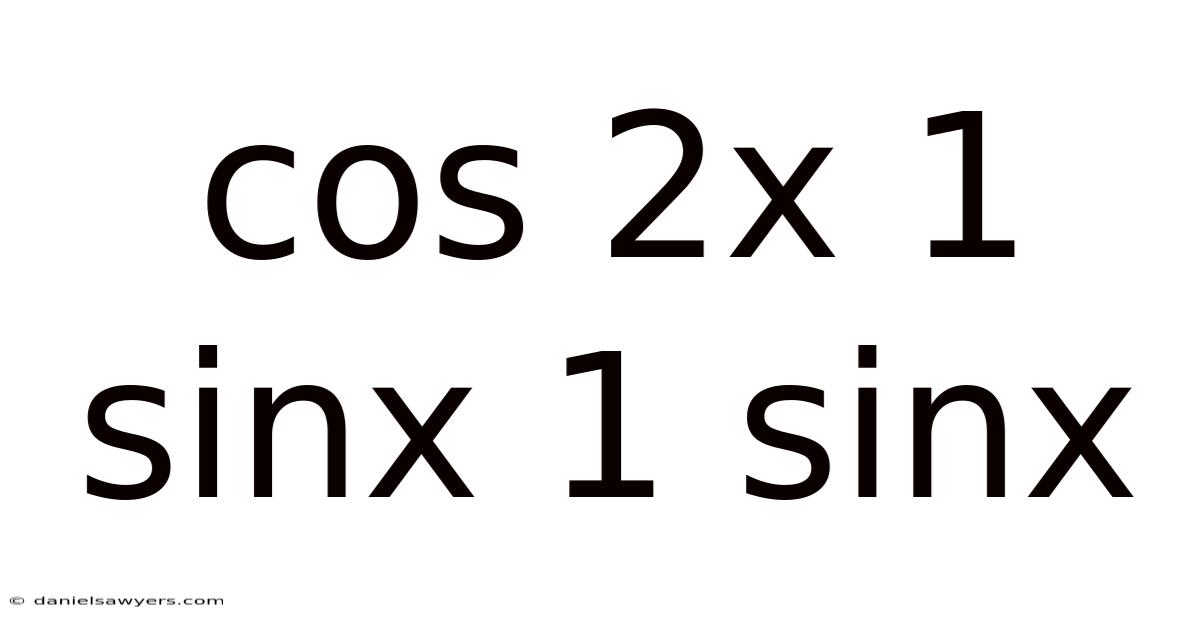
Understanding the Identity cos 2x = 1 – 2 sin² x
Introduction
Trigonometry is the backbone of many advanced mathematical concepts, and one of its most useful tools is the double‑angle identity for cosine. This identity expresses the cosine of a double angle purely in terms of the sine of the original angle:
[ \boxed{\cos 2x = 1 - 2\sin^{2}x} ]
Knowing how to manipulate and apply this formula can simplify complex equations, aid in solving real‑world problems, and deepen your overall grasp of trigonometric relationships. Now, in this article we’ll explore the derivation, practical uses, and common pitfalls when working with cos 2x = 1 – 2 sin² x. By the end you’ll be confident using this identity in algebraic manipulations, calculus, and physics contexts.
The Double‑Angle Identity: Why It Matters
The double‑angle identity is a special case of the angle‑addition formulas. It tells us that the cosine of twice an angle equals one minus twice the square of the sine of that angle. This relationship is not just a algebraic curiosity; it appears in:
- Signal processing – converting between sine and cosine waves.
- Physics – analyzing oscillatory motion and wave interference.
- Calculus – integrating powers of sine or cosine without resorting to complicated substitution.
Because the identity links two fundamental trigonometric functions, mastering it opens the door to many other formulas, such as the half‑angle and product‑to‑sum identities.
Derivation of cos 2x = 1 – 2 sin² x
The derivation starts with the cosine addition formula:
[ \cos (A + B) = \cos A \cos B - \sin A \sin B ]
Set (A = B = x). Then:
[ \cos (x + x) = \cos x \cos x - \sin x \sin x ]
[ \cos 2x = \cos^{2}x - \sin^{2}x ]
Now invoke the Pythagorean identity:
[ \sin^{2}x + \cos^{2}x = 1 \quad\Longrightarrow\quad \cos^{2}x = 1 - \sin^{2}x ]
Substitute (\cos^{2}x) into the previous expression:
[ \cos 2x = (1 - \sin^{2}x) - \sin^{2}x = 1 - 2\sin^{2}x ]
Thus we have rigorously derived the identity. The same steps can be reversed to express (\sin^{2}x) in terms of (\cos 2x) if needed:
[ \sin^{2}x = \frac{1 - \cos 2x}{2} ]
Using the Identity to Solve Equations
1. Solving a Basic Equation
Problem: Solve (\cos 2x = 1 - 2\sin^{2}x) for all real (x).
Solution:
Because the equation is an identity, it holds for every real number (x). This illustrates that the double‑angle formula is not an equation to be solved but a universal truth for any angle Practical, not theoretical..
2. Transforming a More Complex Expression
Problem: Simplify (\displaystyle \frac{\sin^{2}x - \cos^{2}x}{\sin^{2}x}).
Solution:
Replace (\cos^{2}x) using the Pythagorean identity:
[ \cos^{2}x = 1 - \sin^{2}x ]
[ \frac{\sin^{2}x - (1 - \sin^{
Completing the algebraic example
From the Pythagorean identity we have
[ \cos^{2}x = 1-\sin^{2}x . ]
Substituting this into the fraction
[ \frac{\sin^{2}x-\cos^{2}x}{\sin^{2}x} ]
gives
[ \frac{\sin^{2}x-(1-\sin^{2}x)}{\sin^{2}x} =\frac{2\sin^{2}x-1}{\sin^{2}x} =2-\frac{1}{\sin^{2}x}. ]
Since (\displaystyle \csc^{2}x=\frac{1}{\sin^{2}x}), the result can be written as
[ \boxed{,\frac{\sin^{2}x-\cos^{2}x}{\sin^{2}x}=2-\csc^{2}x,}. ]
This compact form shows immediately why the original expression was worth simplifying – the denominator cancels part of the numerator, leaving only a single trigonometric term (or its reciprocal).
Why the double‑angle identity is so handy
The identity
[ \cos 2x = 1-2\sin^{2}x\qquad\text{or}\qquad \sin^{2}x=\frac{1-\cos 2x}{2} ]
lets us swap roles between sine and cosine without having to invoke a separate formula for each case. In practice this means:
-
Rewriting integrals.
To give you an idea,[ \int \sin^{2}x,dx = \int \frac{1-\cos 2x}{2},dx = \frac{x}{2}-\frac{\sin 2x}{4}+C, ]
where the substitution comes directly from the second version of the identity. Without it one would have to integrate (\tfrac12(1-\cos 2x)) manually or resort to a trigonometric reduction That's the whole idea..
-
Simplifying rational expressions.
As shown above, (\dfrac{\sin^{2}x-\cos^{2}x}{\sin^{2}x}) becomes (2-\csc^{2}x), avoiding any square‑roots or ambiguous sign choices. -
Solving equations quickly.
Because the right‑hand side contains only (\
