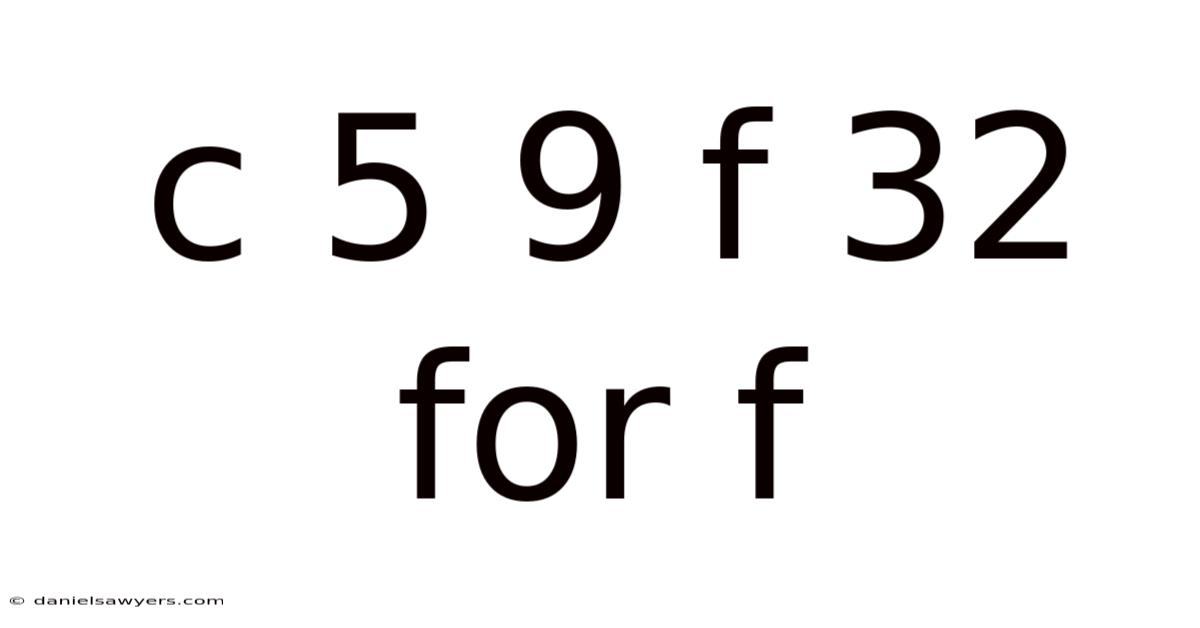
The formula $C = \frac{5}{9}(F - 32)$ is the standard mathematical relationship used to convert a temperature reading from the Fahrenheit scale to the Celsius scale. On the flip side, in many scientific, engineering, and daily life scenarios, the reverse operation is required: taking a known Celsius value and determining the equivalent Fahrenheit temperature. This requires rearranging the equation to solve for $F$. Understanding how to manipulate this formula is a fundamental skill in algebra and physics, bridging the gap between the metric system used globally in science and the imperial system still prevalent in the United States.
Understanding the Temperature Scales
Before diving into the algebraic manipulation, it is helpful to understand why the formula looks the way it does. The Fahrenheit scale, developed by Daniel Gabriel Fahrenheit in the early 18th century, defines the freezing point of water as 32 degrees and the boiling point as 212 degrees (at standard atmospheric pressure). This creates a 180-degree interval between the two phase-change points of water.
The Celsius scale (originally centigrade), developed by Anders Celsius, sets the freezing point of water at 0 degrees and the boiling point at 100 degrees, creating a 100-degree interval. Worth adding: the ratio of these intervals, $\frac{180}{100}$, simplifies to $\frac{9}{5}$. This ratio is the scaling factor between the size of a single degree on each scale. The offset of 32 degrees accounts for the different zero points: 0°C is exactly 32°F That's the part that actually makes a difference..
The Algebraic Derivation: Solving for F
The standard conversion formula provided in most textbooks is:
$C = \frac{5}{9}(F - 32)$
Where:
- C represents the temperature in degrees Celsius.
- F represents the temperature in degrees Fahrenheit.
To solve for F, the goal is to isolate the variable $F$ on one side of the equation. This involves reversing the order of operations (PEMDAS/BODMAS) applied to $F$ in the original formula. Plus, in the original equation, $F$ is first reduced by 32, and then the result is multiplied by $\frac{5}{9}$. To undo this, we must perform the inverse operations in the reverse order: first undo the multiplication, then undo the subtraction.
Step 1: Eliminate the fraction $\frac{5}{9}$. The term $(F - 32)$ is currently being multiplied by $\frac{5}{9}$. The inverse operation is multiplication by the reciprocal, which is $\frac{9}{5}$. Multiply both sides of the equation by $\frac{9}{5}$:
$\frac{9}{5} \times C = \frac{9}{5} \times \frac{5}{9}(F - 32)$
On the right side, $\frac{9}{5}$ and $\frac{5}{9}$ cancel each other out, leaving:
$\frac{9}{5}C = F - 32$
Step 2: Eliminate the subtraction of 32. Now, $F$ has 32 subtracted from it. The inverse operation is addition. Add 32 to both sides of the equation:
$\frac{9}{5}C + 32 = F - 32 + 32$
$F = \frac{9}{5}C + 32$
This is the final, rearranged formula. It allows for direct calculation of Fahrenheit when Celsius is the known input.
Practical Application and Examples
Using the derived formula $F = \frac{9}{5}C + 32$ (which can also be written as $F = 1.8C + 32$), converting temperatures becomes a straightforward two-step arithmetic process: multiply the Celsius temperature by 1.8 (or $\frac{9}{5}$), then add 32 But it adds up..
Example 1: Human Body Temperature Normal human body temperature is approximately $37^\circ\text{C}$. $F = 1.8(37) + 32$ $F = 66.6 + 32$ $F = 98.6^\circ\text{F}$ This confirms the widely cited standard of 98.6°F.
Example 2: A Hot Summer Day Imagine a weather forecast predicting a high of $30^\circ\text{C}$. $F = 1.8(30) + 32$ $F = 54 + 32$ $F = 86^\circ\text{F}$ This is a comfortably warm temperature for many, though approaching heat advisory levels for others.
Example 3: Freezing Point of Water This serves as a verification check. Water freezes at $0^\circ\text{C}$. $F = 1.8(0) + 32$ $F = 0 + 32$ $F = 32^\circ\text{F}$ The formula correctly yields the defined freezing point on the Fahrenheit scale.
Example 4: Negative Celsius Temperatures Winter temperatures often dip below zero Celsius. For $-10^\circ\text{C}$: $F = 1.8(-10) + 32$ $F = -18 + 32$ $F = 14^\circ\text{F}$ This demonstrates that the formula handles negative integers easily.
Mental Math Shortcuts
While the exact formula $F = \frac{9}{5}C + 32$ is necessary for precision, there are estimation techniques useful for quick mental conversions when a calculator is not available It's one of those things that adds up..
The "Double and Add 30" Rule Since $\frac{9}{5} = 1.8$, which is close to 2, a rough estimate can be obtained by doubling the Celsius temperature and adding 30 Easy to understand, harder to ignore. But it adds up..
- For $20^\circ\text{C}$: Double is 40, plus 30 is $70^\circ\text{F}$. (Actual: $68^\circ\text{F}$).
- For $30^\circ\text{C}$: Double is 60, plus 30 is $90^\circ\text{F}$. (Actual: $86^\circ\text{F}$). This method overestimates slightly because 1.8 is less than 2, and 30 is less than 32, but the errors partially cancel each other out near room temperature.
The "Times 2, Minus 10%, Plus 32" Method For a more accurate mental calculation:
- Multiply C by 2.
- Subtract 10% of that result (effectively multiplying by 1.8).
- Add 32.
- For $25^\circ\text{C}$: $25 \times 2 = 50$. 10% of 50 is 5. $50 - 5 = 45$. $45 + 32 = 77^\circ\text{F}$. (Exact).
Common Pitfalls and Errors
When students or professionals first learn to solve for $F$ or apply the formula, several common errors occur Practical, not theoretical..
1. Order of Operations Violations The most frequent mistake is adding 32 before multiplying by $\frac{9}{5}$.
- Incorrect: $F = \frac{9}{5}(C + 32)$
- Correct: $F = \frac{9}{5}C + 32$ Because multiplication takes precedence over addition, the multiplication by $\frac{9}{5}$ applies only to $C$, not to the sum of $C + 32$. Adding
…Adding 32 before the multiplication inflates the result because the scaling factor is applied to a larger number. Practically speaking, for instance, if one mistakenly computes (F = \frac{9}{5}(C+32)) for (C = 20^\circ\text{C}), the calculation becomes (\frac{9}{5}\times52 = 93. 6^\circ\text{F}), which is far above the true (68^\circ\text{F}). Recognizing that the constant 32 represents an offset—not a term to be scaled—helps keep the order of operations clear That alone is useful..
2. Sign Errors with Negative Celsius
When (C) is negative, it is easy to drop the minus sign after multiplying by (\frac{9}{5}). Remember that (\frac{9}{5}) preserves the sign: a negative Celsius yields a negative product before the addition of 32. For (-15^\circ\text{C}), the correct steps are (\frac{9}{5}\times(-15) = -27), then (-27+32 = 5^\circ\text{F}). Forgetting the sign would give (27+32 = 59^\circ\text{F}), an obviously implausible winter temperature.
3. Using the Reciprocal Factor
A common slip is to multiply by (\frac{5}{9}) instead of (\frac{9}{5}). This error occurs when the learner confuses the C→F direction with the inverse F→C formula. A quick sanity check: since Fahrenheit numbers are generally larger than Celsius for everyday temperatures, the factor must be greater than one. If the result looks too small (e.g., converting (25^\circ\text{C}) and obtaining about (45^\circ\text{F})), the reciprocal has likely been used And that's really what it comes down to. Nothing fancy..
4. Premature Rounding
Rounding intermediate values can accumulate noticeable error, especially in scientific contexts. For precise work, keep the full fractional form (\frac{9}{5}C) (or its decimal 1.8) until the final step, then round only the Fahrenheit value to the desired number of significant figures.
5. Misapplying Mental‑Math Shortcuts
The “double and add 30” rule is handy for quick estimates, but it should not be substituted for the exact formula when accuracy matters. Likewise, the “times 2, minus 10%, plus 32” method works only when the 10 % is taken of the doubled value, not of the original Celsius temperature. Misplacing the percentage step leads to systematic over‑ or under‑estimates.
Strategies to Avoid Mistakes
- Write the formula explicitly before plugging in numbers; this reinforces the correct order.
- Check the sign of the Celsius input and carry it through the multiplication.
- Verify the magnitude: Fahrenheit should be higher than Celsius for temperatures above (-40^\circ) (the point where the two scales intersect).
- Use a two‑step check: compute (\frac{9}{5}C) first, then add 32; reverse the process (subtract 32, multiply by (\frac{5}{9})) to see if you retrieve the original Celsius.
- Practice with known reference points (0 °C → 32 °F, 100 °C → 212 °F, (-40^\circ) → (-40^\circ)) to build intuition.
In mastering the Celsius‑to‑Fahrenheit conversion, attention to detail—particularly the order of operations, sign handling, and correct use of the scaling factor—prevents the most frequent errors. By pairing the exact formula with reliable mental‑math shortcuts for estimation and consistently verifying results against known benchmarks, students and professionals alike can move confidently between the two temperature scales. This fluency not only aids everyday comprehension of weather reports and cooking instructions but also underpins accurate scientific communication across disciplines that rely on precise temperature measurements.
