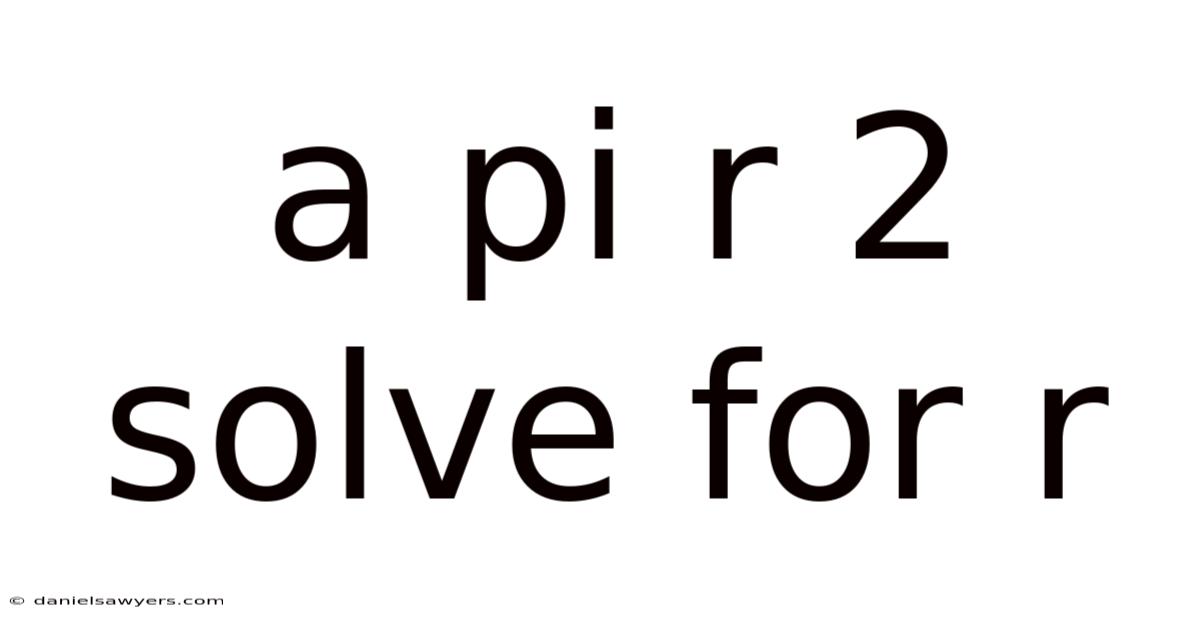
The formula $A = \pi r^2$ is one of the most fundamental equations in geometry, representing the relationship between the area of a circle and its radius. While students often memorize it to find the area when the radius is known, real-world problems frequently require the reverse operation: determining the radius when the area is given. Mastering how to rearrange this equation to solve for $r$ is a critical algebraic skill that bridges basic geometry and advanced problem-solving in physics, engineering, and design.
Understanding the Variables and Constants
Before diving into the algebraic manipulation, Clearly define each component of the equation — this one isn't optional. The formula $A = \pi r^2$ consists of three distinct parts:
- $A$ (Area): This represents the total two-dimensional space enclosed within the circumference of the circle. It is measured in square units (e.g., $cm^2$, $m^2$, $in^2$, $ft^2$).
- $\pi$ (Pi): This is a mathematical constant, an irrational number approximately equal to $3.14159$. It represents the ratio of a circle's circumference to its diameter. In algebraic manipulation, $\pi$ is treated as a constant coefficient, just like a number.
- $r$ (Radius): This is the distance from the center of the circle to any point on its edge. It is a linear measurement (e.g., $cm$, $m$, $in$, $ft$). Because the radius is squared in the formula ($r^2$), the relationship between area and radius is quadratic, not linear.
Recognizing that $r$ is squared dictates the specific algebraic steps required to isolate it. We are not simply dividing or subtracting; we must eventually apply a square root to "undo" the squaring operation.
Step-by-Step Algebraic Derivation
Solving for $r$ involves isolating the variable on one side of the equation using inverse operations. The goal is to transform the equation from $A = \pi r^2$ into the form $r = \dots$
Step 1: Isolate the $r^2$ Term
The variable $r$ is currently multiplied by $\pi$. To isolate $r^2$, we must perform the inverse operation of multiplication, which is division. Divide both sides of the equation by $\pi$:
$ \frac{A}{\pi} = \frac{\pi r^2}{\pi} $
$ \frac{A}{\pi} = r^2 $
At this stage, the term containing the variable is isolated. It is often helpful to rewrite the equation with the variable on the left for standard convention:
$ r^2 = \frac{A}{\pi} $
Step 2: Apply the Square Root
The variable $r$ is currently squared ($r^2$). The inverse operation of squaring is taking the square root. To solve for $r$, take the square root of both sides of the equation:
$ \sqrt{r^2} = \sqrt{\frac{A}{\pi}} $
$ r = \sqrt{\frac{A}{\pi}} $
Step 3: Consider the Principal Root
Mathematically, the square root of a squared variable yields both a positive and negative result ($\pm r$). Still, in the context of geometry, a radius represents a physical length or distance. Distance cannot be negative. Because of this, we strictly accept the principal (positive) square root And that's really what it comes down to..
The final rearranged formula is:
$ r = \sqrt{\frac{A}{\pi}} $
Practical Application: Worked Examples
Understanding the derivation is only half the battle; applying it to numerical problems solidifies the concept. Here are three scenarios ranging from basic calculation to real-world context.
Example 1: Exact Form vs. Decimal Approximation
Problem: A circular garden has an area of $50\pi$ square meters. Find the exact radius and the approximate radius to two decimal places.
Solution:
- Identify $A = 50\pi$.
- Substitute into the derived formula: $r = \sqrt{\frac{50\pi}{\pi}}$.
- Simplify the fraction: The $\pi$ terms cancel out. $ r = \sqrt{50} $
- Simplify the radical (exact form): $\sqrt{50} = \sqrt{25 \times 2} = 5\sqrt{2}$ meters.
- Calculate decimal approximation: $5 \times 1.414 \approx 7.07$ meters.
Key Takeaway: When the area is given in terms of $\pi$, the $\pi$ cancels out immediately, often leaving a simpler radical expression.
Example 2: Numerical Area Without $\pi$
Problem: A circular pizza has an area of $113.04$ square inches. Find the radius. (Use $\pi \approx 3.14$) Not complicated — just consistent..
Solution:
- Identify $A = 113.04$.
- Substitute: $r = \sqrt{\frac{113.04}{3.14}}$.
- Perform division inside the radical: $113.04 \div 3.14 = 36$.
- Take the square root: $r = \sqrt{36} = 6$ inches.
Key Takeaway: Always perform the division inside the radical first (following order of operations) before taking the square root. This avoids rounding errors early in the process Worth knowing..
Example 3: Real-World Unit Conversion
Problem: A circular construction site covers an area of $0.5$ hectares. What is the radius in meters? ($1 \text{ hectare} = 10,000 \text{ m}^2$).
Solution:
- Convert area to square meters: $A = 0.5 \times 10,000 = 5,000 \text{ m}^2$.
- Substitute: $r = \sqrt{\frac{5000}{\pi}}$.
- Estimate using $\pi \approx 3.14159$: $r = \sqrt{\frac{5000}{3.14159}} \approx \sqrt{1591.55}$.
- Calculate root: $r \approx 39.89$ meters.
Common Pitfalls and How to Avoid Them
Even with a straightforward formula, students frequently make specific errors when solving for $r$. Awareness of these traps prevents lost points on exams and mistakes in professional calculations.
1. Forgetting the Square Root
The most common error is stopping at $r^2 = \frac{A}{\pi}$ and reporting $r^2$ as the answer.
- Incorrect: "The radius is $25/\pi$."
- Correct: "The radius is $\sqrt{25/\pi}$ or $5/\sqrt{\pi}$." Fix: Always ask yourself, "Is my variable alone, or is it still squared?"
2. Dividing by $\pi$ After the Square Root
Some students attempt to take the square root of $A$ first, then divide by $\pi$.
- Incorrect: $r = \frac{\sqrt{A}}{\pi}$
- Correct: $r = \sqrt{\frac{A}{\pi}}$ Reason: Order of operations (PEMDAS/BODMAS) dictates that division happens before the square root (which is an exponent of $1/2$) unless parentheses dictate otherwise. The $\pi$ is inside the radical.
3. Ignoring Units (Linear vs. Square)
Area is measured in square units ($m^2, ft^2$). Radius is measured in linear units ($m, ft$) That's the part that actually makes a difference..
- If $A = 25
