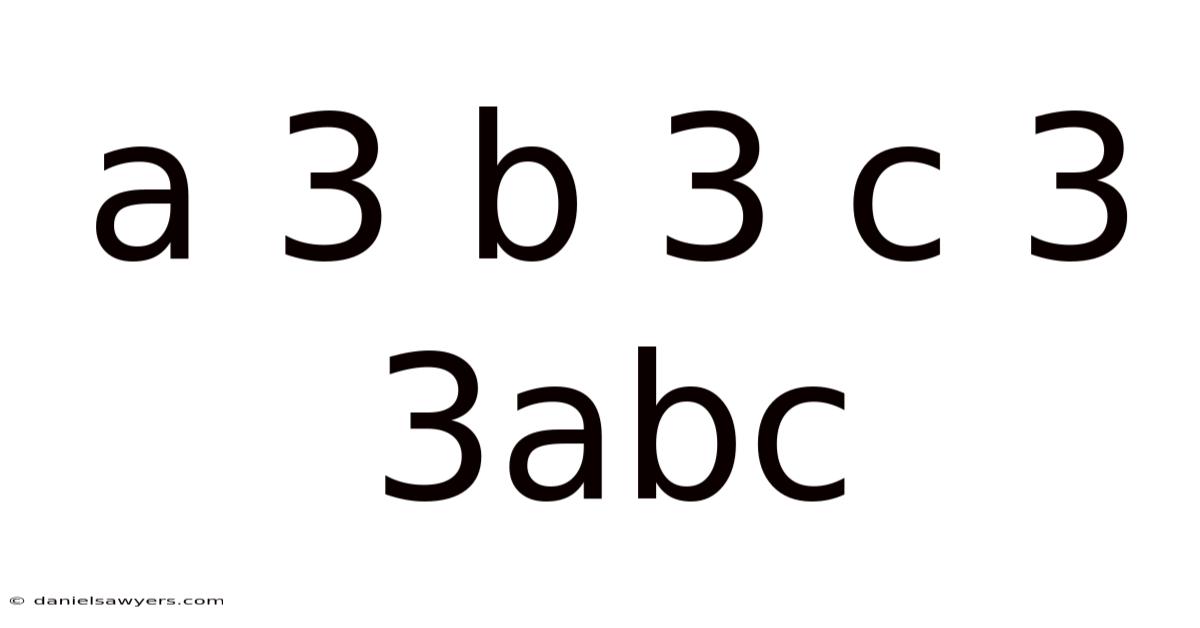
Understanding the Algebraic Identity a³ + b³ + c³ = 3abc
The equation a³ + b³ + c³ = 3abc is more than a simple algebraic curiosity; it is a powerful tool that appears in polynomial factorization, number theory, and even geometry. This identity reveals a deep relationship among three variables and is often introduced in high‑school algebra as a stepping stone to more advanced topics such as symmetric polynomials and Vieta’s formulas. In this article we will explore the origin of the identity, prove it step by step, examine its conditions, and see how it can be applied in real problem‑solving scenarios.
Introduction
When students first encounter the expression a³ + b³ + c³ – 3abc, they may wonder why it factors so neatly. The answer lies in the symmetry of the terms: each variable appears to the third power, and the product abc is the only term of degree three that mixes all three variables. The identity a³ + b³ + c³ = 3abc holds under a special condition—namely, when a + b + c = 0.
[ a^{3}+b^{3}+c^{3}-3abc=(a+b+c)\bigl(a^{2}+b^{2}+c^{2}-ab-bc-ca\bigr). ]
If a + b + c = 0, the right‑hand side collapses to zero, leaving the compact form a³ + b³ + c³ = 3abc. Understanding this relationship not only enriches algebraic intuition but also provides a shortcut for solving cubic equations and verifying numeric identities.
How the Identity Is Derived
Step‑by‑step Proof
-
Start with the known factorization
The expression a³ + b³ + c³ – 3abc can always be written as the product shown above. This factorization is a classic result that can be verified by expanding the right‑hand side:[ \begin{aligned} &(a+b+c)(a^{2}+b^{2}+c^{2}-ab-bc-ca)\ &= a^{3}+ab^{2}+ac^{2}-a^{2}b-abc-a^{2}c\ &\quad +b^{3}+b^{2}c+ab^{2}-ab^{2}-b^{2}c-bc^{2}\ &\quad +c^{3}+ac^{2}+bc^{2}-ac^{2}-bc^{2}-c^{3}\ &= a^{3}+b^{3}+c^{3}-3abc. \end{aligned} ]
All intermediate terms cancel, leaving the original expression.
-
Apply the condition a + b + c = 0
Substituting a + b + c = 0 into the factorization yields:[ 0\cdot\bigl(a^{2}+b^{2}+c^{2}-ab-bc-ca\bigr)=a^{3}+b^{3}+c^{3}-3abc. ]
Since the left side is zero, we obtain:
[ a^{3}+b^{3}+c^{3}=3abc. ]
This is the compact identity we aim to explore.
Alternative Derivation Using Substitution
Another way to see the identity is to set c = -(a+b) (which satisfies a + b + c = 0). Plugging this into a³ + b³ + c³:
[ \begin{aligned} a^{3}+b^{3}+(-(a+b))^{3} &= a^{3}+b^{3}-(a+b)^{3}\ &= a^{3}+b^{3}-(a^{3}+3a^{2}b+3ab^{2}+b^{3})\ &= -3ab(a+b)\ &= 3ab(-a-b)\ &= 3ab,c. \end{aligned} ]
Thus, the identity follows directly from the substitution.
When Does the Identity Hold?
The equality a³ + b³ + c³ = 3abc is not universal; it only true when the sum of the three numbers is zero. This condition can be expressed in several equivalent ways:
- Primary condition: a + b + c = 0.
- Geometric interpretation: If a, b, and c represent directed lengths along a line, they balance each other out.
- Complex numbers: For complex numbers, the same algebraic condition applies, making the identity useful in solving cubic equations with complex roots.
If a + b + c ≠ 0, the identity does not hold. In that case, the factorization still works, but the extra factor (a + b + c) remains non‑zero, leaving a non‑zero remainder It's one of those things that adds up. That alone is useful..
Practical Applications
1. Solving Cubic Equations
Consider a cubic equation of the form x³ – (px)² + (qx) = 0. By setting a = x, b = –px, and c = qx, we can sometimes force a + b + c = 0, allowing us to replace a³ + b³ + c³ with 3abc. This trick simplifies the factorization and reveals hidden roots But it adds up..
2. Proving Number‑Theoretic Statements
In number theory, the identity helps prove that if a, b, and c are integers satisfying a + b + c = 0, then a³ + b³ + c³ is always divisible by 3. This is because 3abc is obviously
This is because 3abc is obviously a multiple of 3, since the product of any three integers is multiplied by the factor 3 when we form 3abc. That said, consequently, whenever a + b + c = 0 the sum of the cubes collapses to a quantity that is always divisible by 3. To give you an idea, taking a = 1, b = 2 and c = –3 (which indeed satisfy a + b + c = 0) gives
[
a^{3}+b^{3}+c^{3}=1+8-27=-18=3\cdot(1\cdot2\cdot(-3))=3abc,
]
confirming the equality in concrete numbers.
Not obvious, but once you see it — you'll see it everywhere.
Beyond the elementary divisibility observation, the identity has a deeper structural role. The well‑known factorisation
[ a^{3}+b^{3}+c^{3}-3abc=(a+b+c)\bigl(a^{2}+b^{2}+c^{2}-ab-bc-ca\bigr) ]
shows that the expression a³ + b³ + c³ – 3abc factors into the product of the linear term (a+b+c) and a quadratic symmetric form. When the linear factor vanishes, the whole product collapses, leaving the simple relation we have been studying. This perspective is especially valuable in algebraic manipulations where one wishes to eliminate a common factor or to rewrite a symmetric polynomial in a more tractable way The details matter here..
In geometric terms, the condition a + b + c = 0 can be interpreted as a balance of directed segments on a line: the three lengths are arranged so that the vectors cancel out. In that setting, the equality a³ + b³ + c³ = 3abc reflects a harmonious interplay that forces the cubic sum to be exactly three times the product of the three lengths. Such a balance appears, for example, in problems involving the roots of a cubic polynomial where the sum of the roots is zero; the identity then becomes a shortcut for computing the sum of the cubes of the roots without expanding the whole cubic.
The identity also finds a place in number theory. If integers a, b, and c satisfy a + b + c = 0, then a³ + b³ + c³ is automatically a multiple of 3, which can be used to prove statements about divisibility or to constrain the possible values of a cubic expression. Worth adding, the same algebraic relation underlies the proof that the discriminant of a cubic with a zero sum of roots reduces to a perfect square, a fact frequently exploited in the study of Galois groups and resolvent equations Simple, but easy to overlook..
The short version: the compact relation
[ a^{3}+b^{3}+c^{3}=3abc ]
holds precisely when a + b + c = 0. This condition, whether interpreted algebraically, geometrically, or in the context of integer divisibility, unlocks a streamlined form of
...unlocks a streamlined form of expressing and leveraging symmetric cubic relationships across diverse mathematical contexts, where the condition (a+b+c=0) reduces a cubic sum to a simple product, thereby simplifying computations in algebra, geometry, and number theory alike That's the whole idea..
In closing, the relation (a^3+b^3+c^3 = 3abc) when (a+b+c=0) stands as a testament to the elegance of algebraic structure. It demonstrates how a seemingly modest condition can unleash powerful simplifications, bridging concrete numeric examples with abstract theoretical frameworks. Whether used to prove divisibility, analyze polynomial roots, or interpret geometric balance, this identity remains a versatile and enduring tool in the mathematician's repertoire, illustrating
...expressing and leveraging symmetric cubic relationships across diverse mathematical contexts, where the condition (a+b+c=0) reduces a cubic sum to a simple product, thereby simplifying computations in algebra, geometry, and number theory alike.
In closing, the relation (a^3+b^3+c^3 = 3abc) when (a+b+c=0) stands as a testament to the elegance of algebraic structure. It demonstrates how a seemingly modest condition can unleash powerful simplifications, bridging concrete numeric examples with abstract theoretical frameworks. Whether used to prove divisibility, analyze polynomial roots, or interpret geometric balance, this identity remains a versatile and enduring tool in the mathematician's repertoire, illustrating the profound interconnectedness that defines the discipline Most people skip this — try not to..
