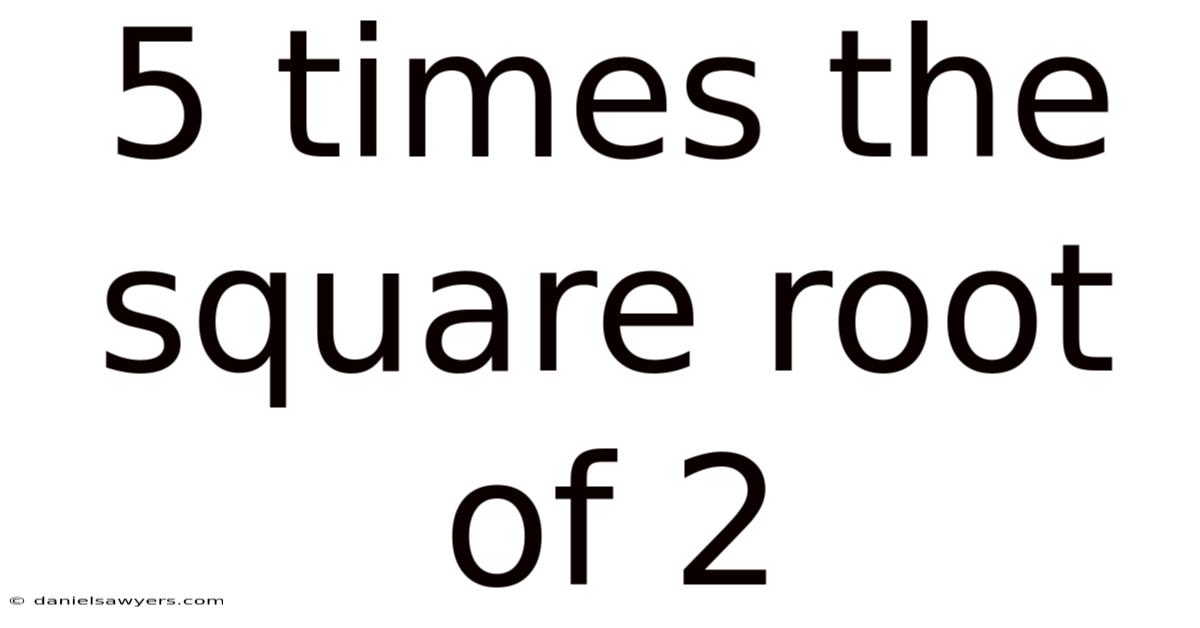
5 times the square root of 2, written as 5√2, is an exact mathematical expression with an approximate decimal value of 7.071. It appears frequently in algebra, geometry, trigonometry, and real-world measurement problems. Understanding both its exact and decimal forms helps prevent rounding errors and makes calculations involving square roots much easier.
Introduction
The expression 5√2 means that the number 5 is multiplied by the square root of 2:
[ 5\sqrt{2}=5\times\sqrt{2} ]
The square root of 2 is the positive number that, when multiplied by itself, equals 2. Its decimal representation continues without ending or repeating:
[ \sqrt{2}\approx1.414213562 ]
Multiplying this value by 5 gives:
[ 5\sqrt{2}\approx7.071067812 ]
For many practical calculations, 5√2 ≈ 7.07 is sufficiently accurate. Still, the exact form 5√2 is often preferable because it preserves the full value without rounding.
Understanding the Expression
A radical expression contains a radicand, which is the number inside the square-root symbol. In 5√2:
- 5 is the coefficient outside the radical.
- √2 is the square root of 2.
- 2 is the radicand.
- The entire expression represents multiplication: 5 × √2.
The coefficient 5 is not inside the square root. Because of this, 5√2 does not mean √(5 × 2), or √10. It means five separate copies of √2 added together:
[ 5\sqrt{2}=\sqrt{2}+\sqrt{2}+\sqrt{2}+\sqrt{2}+\sqrt{2} ]
This distinction is essential when simplifying or combining radical expressions.
Exact Value and Decimal Approximation
The exact value of the expression is:
[ \boxed{5\sqrt{2}} ]
Its approximate decimal value is:
[ \boxed{7.071067812} ]
Different situations require different levels of precision:
- To 1 decimal place: 7.1
- To 2 decimal places: 7.07
- To 3 decimal places: 7.071
- To 5 decimal places: 7.07107
Rounding should generally happen at the end of a calculation. That said, if √2 is replaced with 1. 41 too early, the final answer may be less accurate than necessary.
Why 5√2 Is Already Simplified
A square root can usually be simplified when its radicand contains a perfect-square factor, such as 4, 9, 16, or 25. The number 2 has no perfect-square factor other than 1, so √2 cannot be simplified further Simple, but easy to overlook..
It is possible to rewrite the expression as a single square root:
[ 5\sqrt{2}=\sqrt{25}\times\sqrt{2}=\sqrt{50} ]
On the flip side, √50 is not considered fully simplified because 50 contains the perfect-square factor 25:
[ \sqrt{50}=\sqrt{25\times2}=\sqrt{25}\times\sqrt{2}=5\sqrt{2} ]
Thus, 5√2 is the simplest radical form. It is clearer than √50 because it separates the rational coefficient from the irrational square-root component.
Scientific and Mathematical Explanation
The number √2 is irrational, meaning it cannot be written as an exact fraction of two integers. Its decimal expansion neither terminates nor repeats. Multiplying a nonzero rational number by an irrational number produces another irrational number. Since 5 is rational and √2 is irrational, 5√2 is also irrational.
Squaring the expression demonstrates why it is connected to the number 50:
[ (5\sqrt{2})^2=5^2\times(\sqrt{2})^2 ]
[ (5\sqrt{2})^2=25\times2=50 ]
Because 5√2 is positive, it is the positive square root of 50:
[ 5\sqrt{2}=\sqrt{50} ]
This relationship is useful when comparing
comparing radical quantities. That said, for instance, knowing that 5√2 = √50 allows one to quickly determine which of two radicals is larger without converting to decimals. When comparing √50 and √48, for example, it is immediately clear that √50 > √48 because 50 > 48. Likewise, 5√2 can be compared to expressions like 4√3 or 6√1 by squaring each: (5√2)² = 50, (4√3)² = 48, and (6√1)² = 36, revealing the ordering 6 < 4√3 < 5√2.
Geometric Interpretation
One of the most well-known appearances of √2 is in geometry. The diagonal of a square with side length 1 equals √2, as shown by the Pythagorean theorem:
[ d^2 = 1^2 + 1^2 = 2 \quad \Rightarrow \quad d = \sqrt{2} ]
Scaling that square by a factor of 5 gives a side length of 5 and a diagonal of 5√2. This means 5√2 represents the diagonal of a 5 × 5 square. Equivalently, it is the hypotenuse of a right triangle with both legs measuring 5:
[ h = \sqrt{5^2 + 5^2} = \sqrt{25 + 25} = \sqrt{50} = 5\sqrt{2} ]
This geometric connection appears frequently in architecture, engineering, and design whenever diagonal measurements of square or rectangular layouts are needed.
Applications in Science and Engineering
The value 5√2 arises naturally in several practical contexts:
- Electrical Engineering: In AC circuits, the peak voltage of a sinusoidal signal is √2 times the RMS voltage. A 5-volt RMS signal therefore has a peak amplitude of 5√2 ≈ 7.071 volts.
- Structural Analysis: When a load is distributed equally along two perpendicular members of equal length, the resultant force is found using the Pythagorean theorem, often producing expressions involving √2.
- Signal Processing: Fourier transforms and root-mean-square calculations routinely involve √2, and scaling factors like 5 appear when normalizing amplitudes.
Key Takeaways
- 5√2 is the simplest radical form; it cannot be reduced further because 2 has no perfect-square factors.
- Its exact decimal value is approximately 7.071067812, and rounding should be deferred until the final step.
- The expression is irrational, as it is the product of a nonzero rational number (5) and an irrational number (√2).
- Squaring 5√2 yields 50, confirming that 5√2 is the positive square root of 50.
- Geometrically, it represents the diagonal of a 5 × 5 square and the hypotenuse of a right isosceles triangle with legs of length 5.
Understanding expressions like 5√2 builds a foundation for working with radicals in algebra, geometry, and applied sciences. Mastering the distinction between exact and approximate values, along with the ability to simplify and compare radical forms, equips students and professionals alike with essential mathematical tools used across countless real-world applications.
Historical Context and the Discovery of Irrationals
The concept of √2 has a rich history dating back to ancient Greece. The Pythagoreans, who famously believed that all numbers could be expressed as ratios of integers, were deeply unsettled by the discovery that the diagonal of a unit square could not be represented as a simple fraction. This revelation, often attributed to Hippasus of Metapontum, proved that √2 is irrational. When multiplied by a rational integer like 5, the resulting value, 5√2, inherently retains this irrational nature. The acceptance of such numbers fundamentally shifted the trajectory of mathematics, paving the way for the comprehensive study of the real number system.
Algebraic Operations and Manipulations
Working with 5√2 in algebraic equations requires a solid grasp of radical operations. Here's a good example: multiplying 5√2 by another radical, such as 3√8, involves simplifying the components first:
[ 5\sqrt{2} \times 3\sqrt{8} = 15\sqrt{16} = 15 \times 4 = 60 ]
Similarly, rationalizing denominators is a common procedure where 5√2 might appear. When 5√2 is in the denominator, multiplying the fraction by its conjugate or by itself yields 50 in the denominator, which can then be simplified to a rational number. If an expression contains a denominator of √2, multiplying both the numerator and denominator by √2 will eliminate the radical from the bottom. These operations highlight the importance of maintaining exact values throughout calculations to ensure mathematical precision.
Conclusion
The short version: the expression 5√2 is far more than a simple mathematical artifact; it is a fundamental value that bridges pure mathematics and practical application. From its geometric roots as the diagonal of a square to its critical role in electrical engineering and signal processing, 5√2 demonstrates the pervasive nature of irrational numbers in our physical world. By understanding its exact form, decimal approximation, and algebraic properties, one gains a deeper appreciation for the elegance and utility of radical expressions Simple, but easy to overlook..
