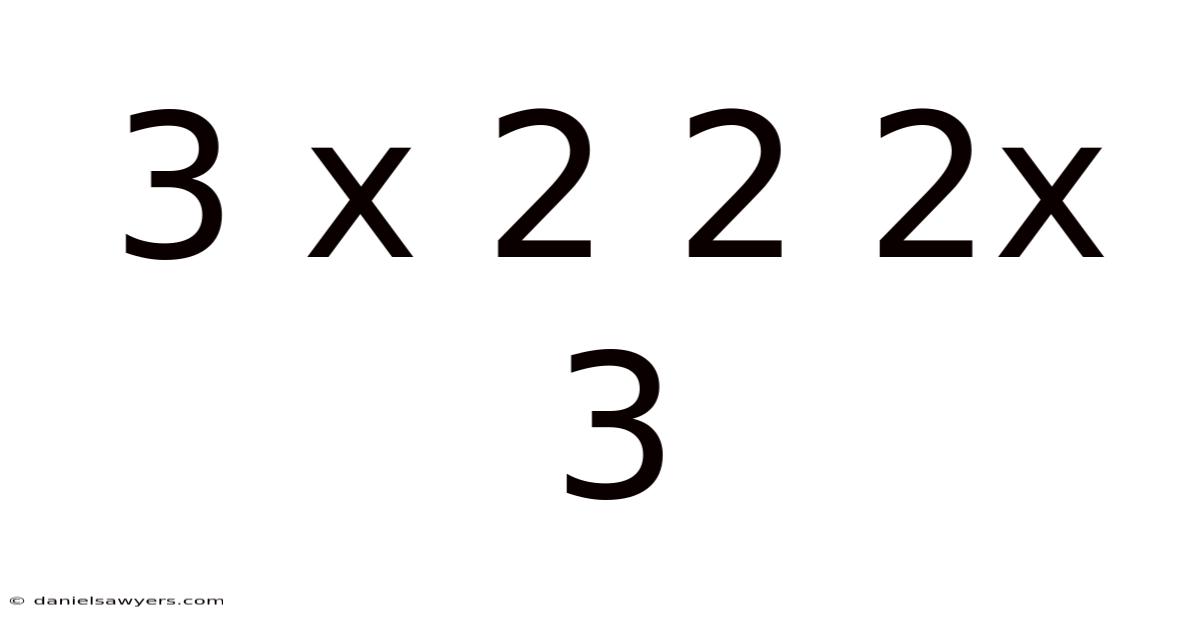
Understanding how to multiply binomials and factor the resulting trinomials is a cornerstone of algebraic fluency. The expression (3x + 2)(2x + 3) serves as a perfect case study because it involves coefficients greater than one in both binomials, requiring careful application of the distributive property. Whether you are expanding brackets to simplify an expression or factoring a quadratic trinomial like $6x^2 + 13x + 6$ to find its roots, mastering this specific pattern builds the confidence needed for advanced calculus, physics, and engineering coursework Worth knowing..
The Anatomy of the Expression: (3x + 2)(2x + 3)
Before diving into the mechanics, let’s identify the components. We have two binomials—polynomials with two terms—being multiplied together.
- First Binomial: $3x + 2$ (Coefficient of $x$ is 3, constant is 2)
- Second Binomial: $2x + 3$ (Coefficient of $x$ is 2, constant is 3)
Notice the symmetry: the coefficients 3 and 2 swap positions between the $x$-term and the constant term. This symmetry often leads to a "middle term" in the expanded form that is the sum of two distinct products, a classic setup for the AC Method of factoring later on.
Expanding Binomials: The FOIL Method
The most common mnemonic for multiplying two binomials is FOIL, which stands for First, Outer, Inner, Last. This ensures every term in the first bracket multiplies every term in the second bracket exactly once.
Step-by-Step Expansion
1. First (F): Multiply the first terms in each binomial. $3x \cdot 2x = 6x^2$
2. Outer (O): Multiply the outer terms. $3x \cdot 3 = 9x$
3. Inner (I): Multiply the inner terms. $2 \cdot 2x = 4x$
4. Last (L): Multiply the last terms. $2 \cdot 3 = 6$
Combining Like Terms
Now, sum the four partial products: $6x^2 + 9x + 4x + 6$
Combine the $x$-terms ($9x + 4x = 13x$): $6x^2 + 13x + 6$
Result: $(3x + 2)(2x + 3) = 6x^2 + 13x + 6$
Pro Tip: Always write the $x^2$ term first, followed by the $x$ term, then the constant (Standard Form). This makes checking your work and factoring later significantly easier Small thing, real impact..
Alternative Method: The Distributive Property (Area Model)
While FOIL is fast, the Distributive Property (often visualized as an Area Model or Box Method) is more dependable because it extends effortlessly to polynomials with three or more terms
