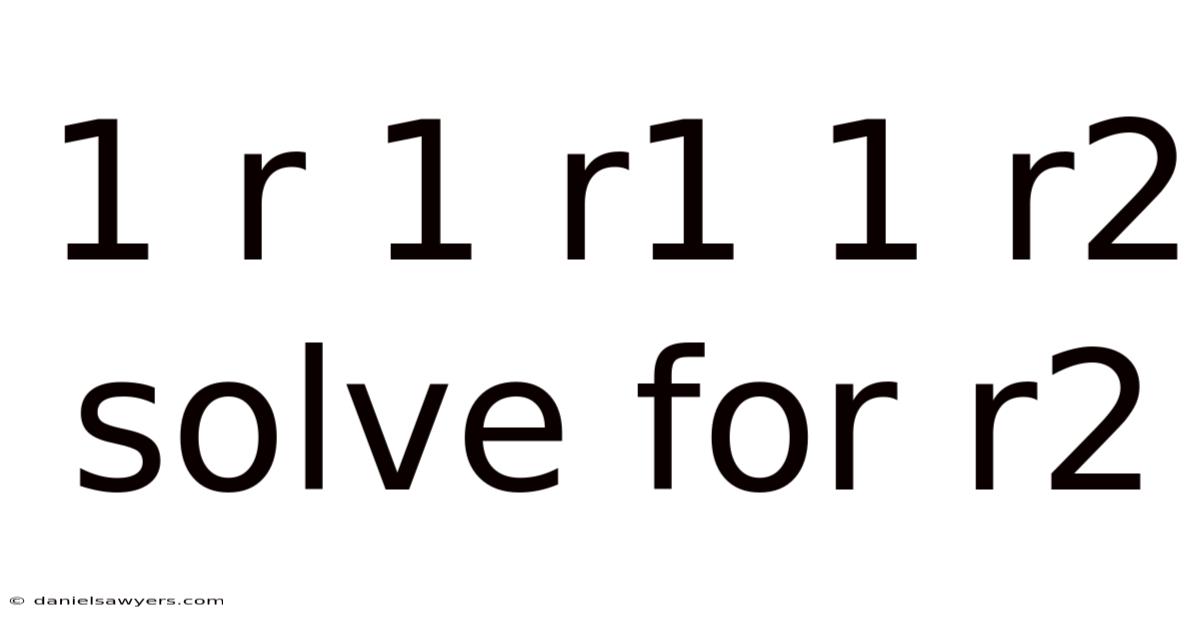
The equation 1/R = 1/R1 + 1/R2 is the fundamental relationship for two resistors connected in parallel, and solving it for R2 gives the formula R2 = (R × R1) ÷ (R1 − R). Mastering this rearrangement is one of the most useful skills in basic electronics and physics, because it lets you work backwards from a desired total resistance to find the missing component value. Below is a complete, step-by-step walkthrough of the algebra, the reasoning behind it, worked examples, common pitfalls, and the practical situations where this calculation shows up.
What the Formula Actually Means
When two resistors share the same two nodes — that is, when they are connected in parallel — the voltage across each of them is identical, but the current splits between the two branches. Practically speaking, because current divides, the overall opposition to flow drops. That is why the total resistance of a parallel combination is always smaller than the smallest individual resistor in that combination.
People argue about this. Here's where I land on it.
The reciprocal form of the rule is:
1/R = 1/R1 + 1/R2
Here:
- R is the equivalent (total) resistance of the pair
- R1 is the resistance of the first branch
- R2 is the resistance of the second branch
Electrical engineers often rewrite this using conductance, the reciprocal of resistance, measured in siemens (S). In real terms, in conductance terms, parallel resistances simply add: G = G1 + G2. That single idea explains why the reciprocals appear in the first place.
Solving for R2, Step by Step
Start with the original equation and isolate R2 using ordinary algebra.
Step 1 — Write the starting equation. 1/R = 1/R1 + 1/R2
Step 2 — Move the 1/R1 term to the other side by subtracting it from both sides. 1/R2 = 1/R − 1/R1
Step 3 — Combine the right side over a common denominator, which is R × R1. 1/R2 = R1/(R × R1) − R/(R × R1) 1/R2 = (R1 − R)/(R × R1)
Step 4 — Invert both sides to solve for R2. R2 = (R × R1) ÷ (R1 − R)
That is the final result. Now, notice that the denominator is R1 − R, not R − R1. Getting that order wrong flips the sign of your answer, which is the single most common error in this derivation.
A Worked Numerical Example
Suppose you need a total resistance of R = 100 Ω, and you already have a 300 Ω resistor (R1) available. What value of R2 must you place in parallel with it?
R2 = (R × R1) ÷ (R1 − R) R2 = (100 × 300) ÷ (300 − 100) R2 = 30,000 ÷ 200 R2 = 150 Ω
Verification: 1/300 + 1/150 = 1/300 + 2/300 = 3/300 = 1/100, so R = 100 Ω. The answer checks out.
The Product-Over-Sum Shortcut
If you instead know both resistor values and want the total, the same equation simplifies to the familiar product-over-sum form:
R = (R1 × R2) ÷ (R1 + R2)
Here's one way to look at it: with R1 = 220 Ω and R2 = 330 Ω: R = (220 × 330) ÷ (220 + 330) = 72,600 ÷ 550 = 132 Ω
As expected, 132 Ω is less than 220 Ω, the smallest resistor in the pair. You can use this fact as a quick sanity check on every calculation you do.
Physical Sanity Checks
Before trusting your answer, run these three tests:
- R1 must be greater than R. If R1 ≤ R, the denominator becomes zero or negative, and no physical resistor can fix that. A zero denominator means R2 would have to be infinite — an open circuit — which makes sense, because leaving a branch empty leaves R = R1.
- The result must be positive. A negative resistance signals an algebra slip, almost always a reversed subtraction.
- R must remain the smallest value in the circuit. If your computed R2 turns out larger than what the physics allows, recheck
your algebra or your measured values.
R2 must be finite and positive. If R1 equals R exactly, the denominator becomes zero and R2 would have to be infinite—an open circuit. If R1 is smaller than R, no physical resistor can produce that total when placed in parallel.
Practical Tips
When selecting a real resistor, remember that standard values come in E-series steps (E12, E24, etc.), so your calculated R2 may not exist exactly. Choose the nearest standard value and recalculate the actual total resistance to confirm it still meets your design tolerance. Also check power ratings: current splits between branches, but each resistor still dissipates power based on the full voltage across the parallel pair.
People argue about this. Here's where I land on it It's one of those things that adds up..
Conclusion
The reciprocal rule for parallel resistors exists because conductances add directly. Solving for an unknown branch is straightforward algebra, but the sign of
