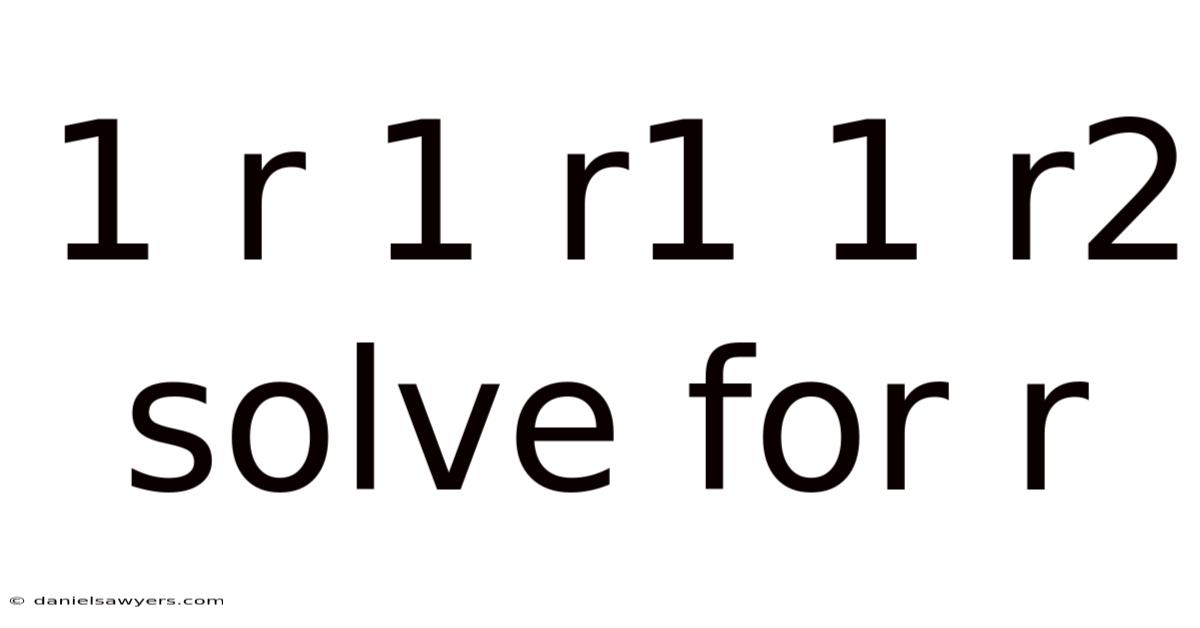
How to Solve for R in the Equation 1/R = 1/R1 + 1/R2: A Complete Guide
The equation 1/R = 1/R1 + 1/R2 appears frequently in physics and engineering, especially when dealing with parallel circuits, lens systems, and harmonic means. Practically speaking, many students and professionals encounter this formula and immediately feel stuck — not because the math is inherently difficult, but because the reciprocal structure can feel unfamiliar at first glance. Solving for R in this equation is actually a straightforward algebraic process once you understand the logic behind each step. This guide will walk you through the entire process, explain why each step works, and show you real-world applications so you can confidently handle this type of problem every time.
Understanding the Formula
Before jumping into the solution, it helps to understand what the equation represents. The expression 1/R = 1/R1 + 1/R2 describes the relationship between a combined quantity R and two individual quantities R1 and R2 when they are arranged in parallel. In electrical circuits, R represents the equivalent resistance of two resistors connected in parallel. In optics, it can represent the combined focal length of two thin lenses in contact. In mathematics, it is a classic example of combining reciprocals.
The key insight is that R is not simply R1 + R2. Instead, you are working with the reciprocals of each value. This is why the solving process requires a few extra algebraic steps compared to a simple linear equation.
Step-by-Step Solution
Let us solve for R systematically. Starting from the original equation:
1/R = 1/R1 + 1/R2
Step 1: Combine the fractions on the right side.
To add 1/R1 and 1/R2, you need a common denominator. The common denominator for these two fractions is R1 × R2. Rewrite each fraction:
1/R1 = R2 / (R1 × R2) 1/R2 = R1 / (R1 × R2)
Now add them together:
1/R = (R2 + R1) / (R1 × R2)
You can rewrite this as:
1/R = (R1 + R2) / (R1 × R2)
Step 2: Take the reciprocal of both sides.
Since R is in the denominator on the left side, the simplest way to isolate it is to flip both sides of the equation. The reciprocal of 1/R is R, and the reciprocal of (R1 + R2) / (R1 × R2) is (R1 × R2) / (R1 + R2). This gives you:
R = (R1 × R2) / (R1 + R2)
And that is your final answer. The equivalent resistance or combined value R equals the product of R1 and R2 divided by their sum.
Why This Works: The Scientific Explanation
The reason this formula takes this particular shape comes from the physics of parallel systems. Here's the thing — when two resistors are connected in parallel, the total current has two paths to flow through. Worth adding: this means the overall resistance must be less than either individual resistance. If you plug in numbers, you will notice that R is always smaller than both R1 and R2 — a fact that makes physical sense because adding more paths for current reduces the overall opposition to flow Simple, but easy to overlook..
The product-over-sum formula R = (R1 × R2) / (R1 + R2) captures this behavior elegantly. When R1 and R2 are equal, the formula simplifies to R = R1/2, meaning the equivalent resistance is exactly half of either individual resistor. When one resistor is much larger than the other, the equivalent resistance is dominated by the smaller value, which also aligns with physical intuition.
Worked Example
Let us apply the formula with concrete numbers to solidify the concept. Suppose R1 = 6 ohms and R2 = 3 ohms Most people skip this — try not to..
Using the formula:
R = (6 × 3) / (6 + 3) R = 18 / 9 R = 2 ohms
Notice that 2 ohms is indeed less than both 6 ohms and 3 ohms, which confirms our understanding of parallel resistance. If you had simply added them, you would have gotten 9 ohms, which would be correct for a series connection but incorrect for a parallel one.
Common Mistakes to Avoid
- Forgetting to find a common denominator. Many students try to add 1/R1 and 1/R2 directly without converting them to equivalent fractions. Always remember that you cannot add fractions with different denominators.
- Taking the reciprocal incorrectly. After combining the right side into a single fraction, some learners forget to flip both the numerator and the denominator when taking the reciprocal of both sides.
- Confusing series and parallel formulas. In a series circuit, resistances simply add: R = R1 + R2. In a parallel circuit, you must use the reciprocal formula. Mixing these up leads to incorrect results.
- Ignoring units. Always carry your units through the calculation. If R1 and R2 are in ohms, R will also be in ohms.
Applications in Real Life
The ability to solve for R in this equation has practical value across multiple fields:
- Electrical engineering: Designing circuits with specific equivalent resistances using standard resistor values.
- Electronics troubleshooting: Calculating unknown resistor values in parallel networks.
- Optics: Determining the focal length of combined lenses.
- Fluid dynamics: Modeling combined flow resistances in parallel piping systems.
- Thermal systems: Analyzing combined thermal resistances in heat transfer problems.
Quick Reference Formula
For easy memorization, keep this summary handy:
- Original form: 1/R = 1/R1 + 1/R2
- Solved form: R = (R1 × R2) / (R1 + R2)
- Special case when R1 = R2: R = R1 / 2
Frequently Asked Questions
Can this formula be extended to more than two resistors? Yes. For three or more resistors in parallel, you simply add more reciprocal terms: 1/R = 1/R1 + 1/R2 + 1/R3 + ... and then solve for R using the same reciprocal approach.
What if one of the resistors is zero? If R2 = 0, the formula breaks down because you would be dividing by zero. Physically, a zero-resistance path (a short circuit) means all current flows through that path, and the equivalent resistance becomes zero.
Does this work for negative values? In physical applications, resistances are always positive. Negative resistance is a concept that appears in some active electronic components but requires different analysis methods beyond this basic formula.
Conclusion
Solving for R in the equation 1/R = 1/R1 + 1/R2 is a fundamental skill that opens the door to understanding parallel systems
in electronics, physics, and engineering. Practically speaking, by mastering this calculation, you gain insight into how multiple pathways interact to create a unified response. Whether you're designing a circuit board, analyzing optical systems, or modeling fluid flow, the principles remain consistent: combining parallel elements requires working with reciprocals, finding common denominators, and carefully inverting your results. Plus, remember that the equivalent resistance in any parallel configuration will always be smaller than the smallest individual resistor—a useful check for verifying your work. With practice and attention to units, this seemingly simple algebraic manipulation becomes a powerful tool for solving complex real-world problems across numerous scientific and technical disciplines Nothing fancy..
